
At a glance
- Every software-delivery stage assisted by a specialist agent.
- Code review, QA, and repeatable delivery work automated.
- One shared context layer that learns from every run.
BLG gained more than faster code generation. It gained a delivery system that reduced coordination work, protected engineering quality, and gave the team evidence that each change was ready to move forward.
The challenge
BLG Technologies needed to deliver a complex, multi-phase product without sacrificing product quality, architecture, or release confidence. A small team had to coordinate requirements, technical decisions, implementation, review, QA, and release planning across a growing body of work.
The challenge was not simply writing code faster. The team also needed to ensure that product criteria were met, architectural decisions stayed consistent, review feedback was resolved, and every change was validated before release. Keeping that process moving manually would have required more people, meetings, and coordination.
The approach
BLG started with Prinevo's Planning Agent. It analysed the complete project, broke it into eight outcome-based phases, identified dependencies, and defined the expected output and completion criteria for each phase. This gave the team a clear delivery roadmap before implementation began.
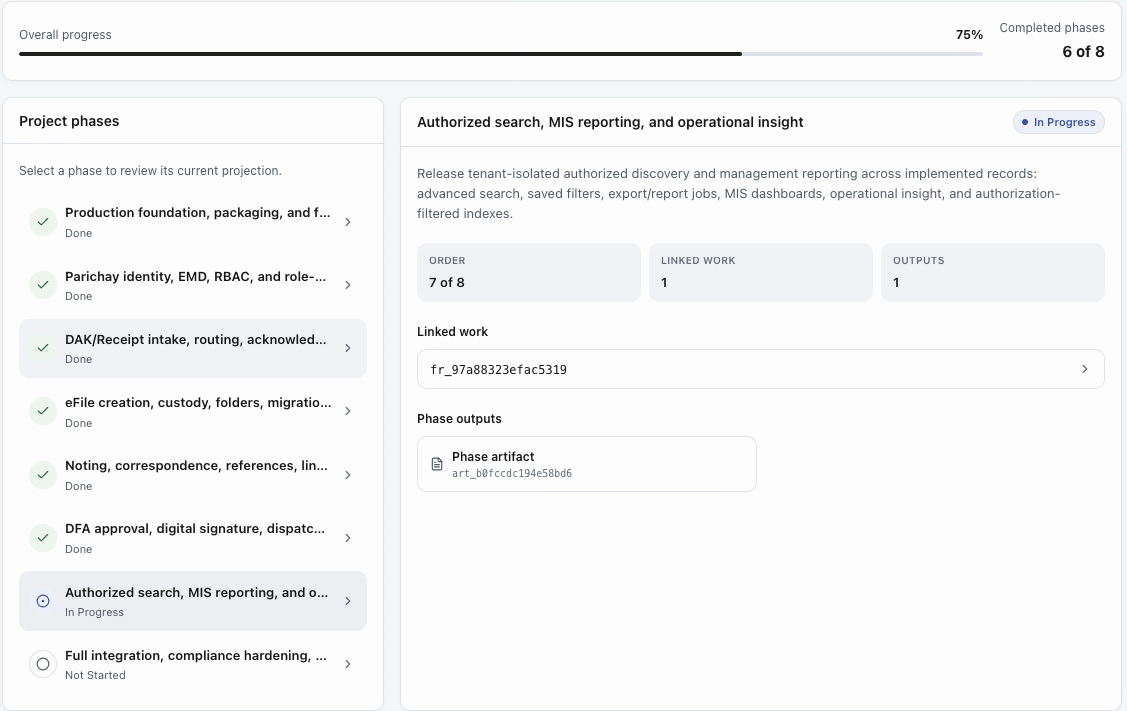
Each phase then moved through one coordinated, seven-stage delivery workflow. Every step of the software development lifecycle was assisted by a specialist agent.
A team of agents for the complete delivery lifecycle
With Prinevo, BLG did not get a single coding assistant. It got a coordinated team of specialist agents supporting every step of software delivery:
- Product Agent turns the business request into product requirements and acceptance criteria.
- Architect Agent defines the system design, boundaries, dependencies, and technical direction.
- Planning / Lead Agent breaks larger projects into outcome-based phases, maps dependencies, and converts the architecture into sequenced implementation and test plans.
- Implement Agent writes code and tests, with multiple implementation agents able to work across separate streams.
- Code Review Agent reviews quality, security, architecture, and contracts, then sends findings back for correction.
- QA / Verify Agent brings up services, prepares test data, validates the feature against the original requirements, and captures evidence.
- Deploy Plan Agent prepares release order, operational checks, monitoring, and a rollback plan.
Humans remained responsible for direction and important approvals. Agents handled the repeatable analysis, execution, coordination, and evidence collection between those decisions.
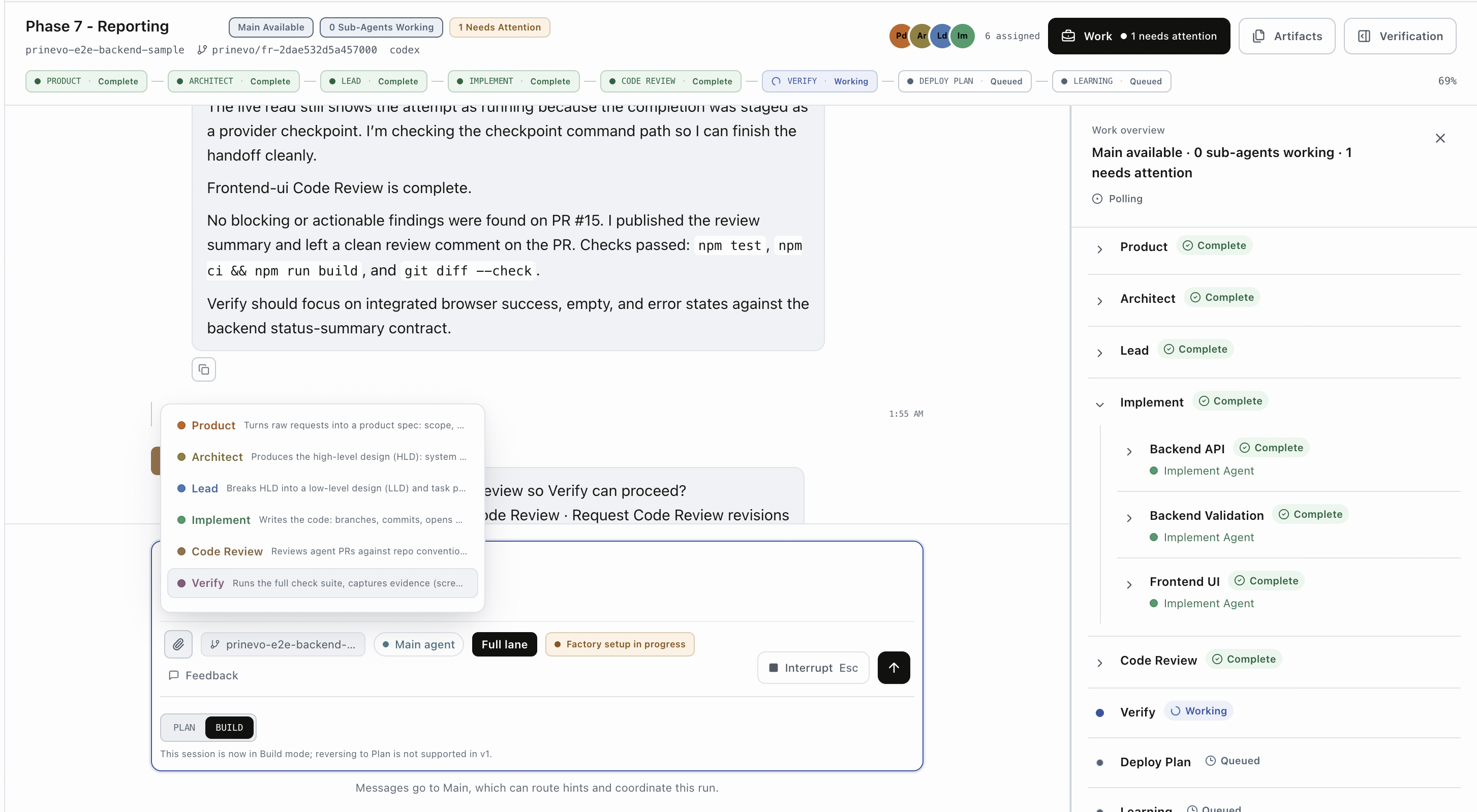
Every specialist worked from the same central context layer: product requirements, architecture decisions, repository knowledge, ownership, prior feedback, and validation evidence. This allowed each agent to understand not only the task, but also how the product and engineering organization expected it to be delivered.
The Product agent turned the request into clear requirements and acceptance criteria. The Architect and Lead agents established the technical direction and broke the work into executable tasks. Implement agents could then work across multiple streams while remaining aligned with the same plan.
The Code Review agent inspected changes and returned actionable feedback to the Implement agent. When an issue was found, the feedback-and-fix loop continued until it was resolved, reducing the review burden on senior engineers.
The QA agent used that same context to bring up services, prepare the environment, and validate each change against the original product requirements. Test results, logs, screenshots, and other evidence stayed attached to the delivery run, so the team could review what had been verified without reconstructing the work manually.
For small, low-risk changes, BLG used a shorter Quick Lane: Implement, Code Review, Verify. This removed unnecessary stages while preserving shared context, review, and validation.
Prinevo also allowed BLG to use the right model for each task. High-reasoning models could be assigned to product and architecture decisions, while faster, more economical models handled routine implementation. Work ran in cloud environments and could continue without occupying an engineer's laptop.
Automation that kept delivery moving
BLG could automate repeatable engineering work without turning the delivery process into a black box. Prinevo could start a code review when an agent opened a pull request, run QA against a selected PR, or move an approved small change through implementation, review, and verification automatically.
Automations could be scheduled or triggered from tools the team already used. Approved bugs could become sandbox-validated fixes, routine pull requests could receive consistent review, and release preparation could continue in the cloud while the team was offline.
The team remained in control. High-impact product, architecture, and release decisions could require human approval, while well-defined, low-risk work continued automatically when the required evidence was present. Every automated action, result, blocker, and approval stayed visible in the same delivery thread.
The result
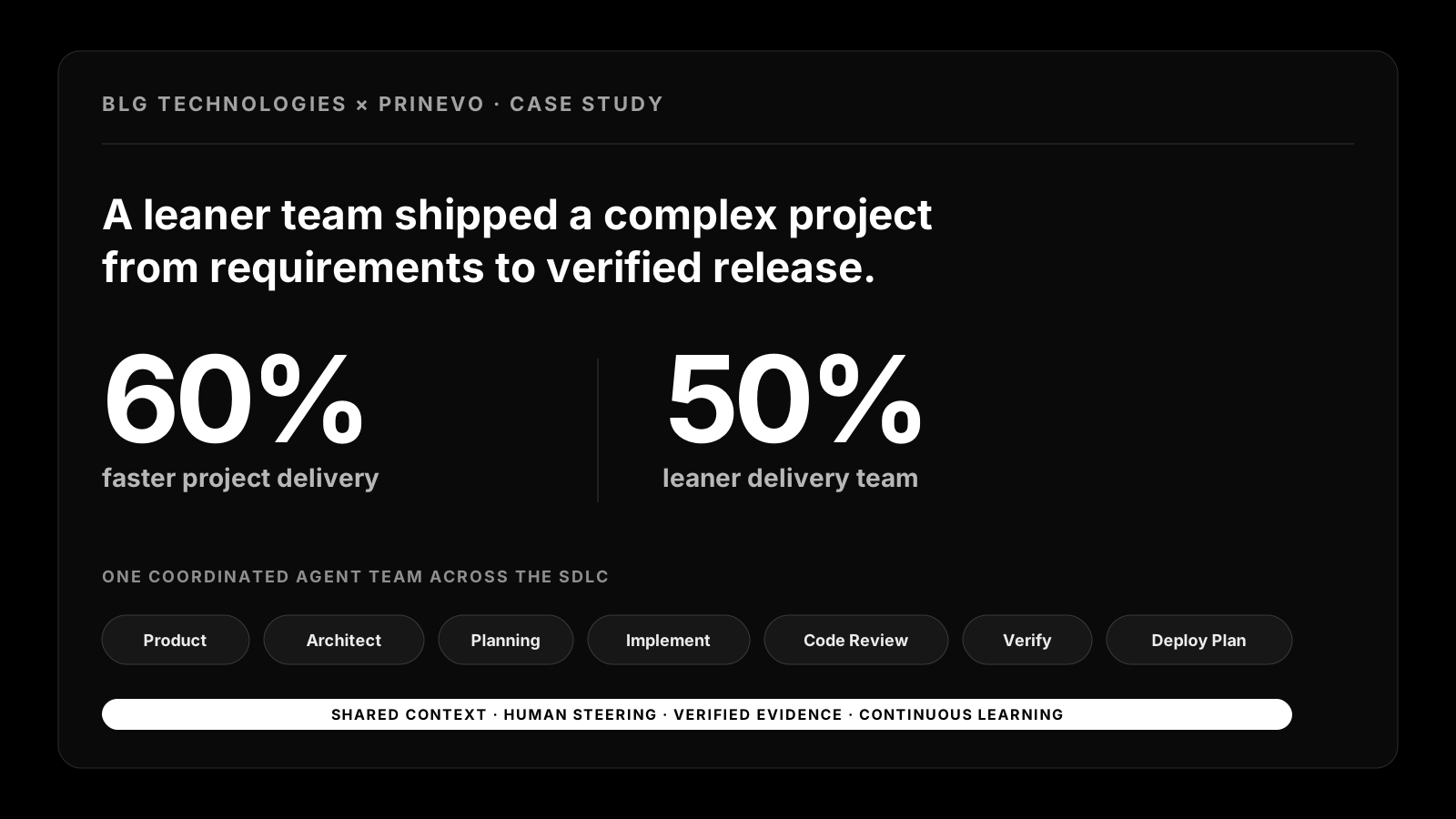
- 60% faster delivery across the project.
- 50% fewer people required for day-to-day execution.
- Less manual time spent coordinating, reviewing, and testing.
- Repeatable code review, QA, and delivery tasks automated in the cloud.
- Real-time visibility into every phase, gate, blocker, and owner.
- Model and token spend measurable by feature and delivery stage.
Instead of chasing updates across tools and agent sessions, the team had one place to see project status, completed artifacts, active agents, blocked gates, responsible owners, review findings, and verification evidence. People could focus on decisions and feedback while the agent team handled much of the execution and coordination.
Existing Codex and Claude subscriptions could be connected, helping BLG avoid unnecessary platform costs. Usage could be measured by feature, agent, stage, and model, making it possible to connect token spend with delivered outcomes.
Manage every project in one shared system
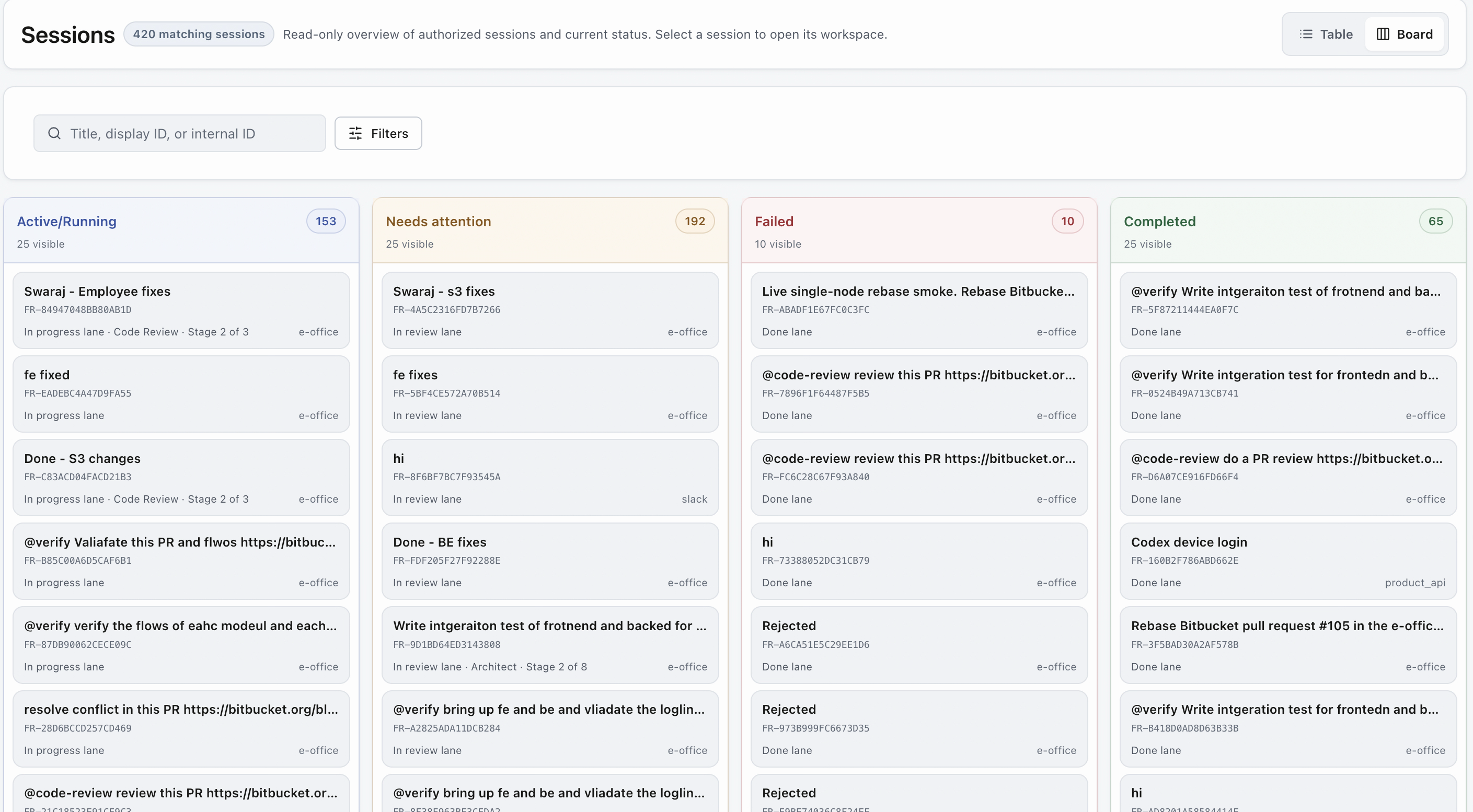
A portfolio view showed what was running, what needed attention, what had failed, and what was complete. Each project connected people and specialist agents through common context, reusable skills, quality gates, and verification standards.
When one engineer, reviewer, or agent learned something useful, that knowledge could improve how the entire team worked. Proven instructions became shared skills, review findings strengthened future checks, and validated decisions remained available for the next feature. New team members and agents could begin with the organization's delivery knowledge instead of rebuilding it from scratch.
A context layer that learns and improves
The central context layer connected every phase, agent, and human decision. It carried requirements, architecture, code knowledge, shared skills, review feedback, QA evidence, and approved learnings from one stage to the next. The team could see what was happening, where work was blocked, and who was responsible in one shared delivery thread.
Reviewer decisions, failed checks, successful fixes, and verification evidence improved the context, skills, and quality gates used next time. Repeated work could become reusable automation, including automated PR reviews, QA validation, and release workflows.
Prinevo gave BLG a coordinated team of specialist agents, backed by a context layer that learns and improves, so a lean team could move from requirement to verified release with control and visibility.
Prinevo.ai