You give an agent a feature request. It writes code and opens a PR. What happens between that request and a change your team can actually put in production?
That is the workflow we are building Prinevo around. A production change needs more than an implementation agent: it needs the right organizational context, coordination across agents and repositories, verification against the original request, governance over what agents can do, and a way to learn from the outcome. The request, decisions, code, review findings, test results, and remaining risks stay connected in one delivery run. An accountable human owner can steer each stage.
There are three ways to start: use a quick lane for a small, low-risk change; use the full lane when the change needs product, architecture, or cross-repo coordination; or call an individual agent for a bounded task such as reviewing a PR or verifying an existing change. The path should fit the work.
The flow can also start automatically from an approved Linear ticket: Prinevo coordinates the agents, implements and reviews the change, verifies it in a sandbox, and, when the checks pass, raises a verified, reviewer-ready PR with the evidence attached. Any human approvals required by the team’s policy remain in place.
Context: start with the outcome and how the company works
Consider a trial-to-paid feature. When a customer upgrades, the UI should show paid access immediately. The entitlement API must enforce it, and the billing worker must handle a delayed event without taking access away.
That example is illustrative. The important point is that “change three repositories” is not the outcome. The outcome is the customer behavior, including the delayed-event case.
Prinevo starts with the request and relevant organizational context: product rules, affected repositories, service contracts, owners, architecture decisions, prior failures, and release constraints. This is not just a document search before coding. The same accepted facts and artifact versions need to follow Product, Architect, Implement, Code Review, Verify, and release planning, even when different agents or models do the work.
If the request leaves a material question open, the responsible owner can answer it before implementation turns an assumption into code. The run keeps the accepted requirement and its revisions visible, so later stages know which version they are working from. If the billing contract changes during the run, that new decision needs to reach the frontend and worker work too. Otherwise the team has shared context in name but different assumptions in practice.
Quick lane: move small changes without unnecessary gates
A contained bug fix may have one known owner, one repository, and a clear way to check the result. It does not need a new PRD, architecture review, and task breakdown before anyone edits a file.
In the quick lane, the path is shorter:
Request and existing context → Implement → Code Review → Verify → release decisionThe team can configure this lane so low-risk work advances without a human approval at every step. No human gate does not mean no checks. The Implement agent still makes the change, the Code Review agent inspects it, and the Verify agent checks the behavior against the request. An accountable engineer owns the outcome and can intervene if the scope changes, a check fails, or the evidence is weak. Release still follows the team’s authorized deployment policy.
If a supposedly small fix reveals a shared contract or migration risk, the run should stop treating it as small. The owner can redirect it into the fuller path. Fast is useful only while the assumptions that made the quick lane appropriate remain true.
Full lane: get the decisions right before code fans out
For a cross-repo feature, API change, migration, infrastructure change, or risky rollout, Prinevo can use a fuller delivery path. The Product agent turns the request into scope and acceptance criteria. The Architect agent examines boundaries, contracts, compatibility, and rollout implications. A Lead or Planning agent breaks the design into repository-level work and checks. Implement agents then work on the affected streams. Code Review and Verify assess the result, and release planning captures deployment order and operational checks where needed.
The stages are not just a row of agents. Each has an accountable owner. A product owner can correct the PRD. An architect can challenge the HLD. A tech lead can revise the LLD or task sequence. A code review owner can set the quality bar. A verification owner can decide whether the evidence covers the intended behavior. The owner reviews the decision that matters; they do not need to watch every tool call.
Human gates are configurable. A team may require approval of a contract change before implementation, while allowing an ordinary task plan to advance automatically. Another team may want explicit sign-off on PRD, HLD, and release plan. The gate should refer to a specific artifact revision. If that artifact changes materially, the approval question needs to be revisited.
The full lane also lets implementation work happen in parallel where dependencies permit. Frontend and backend agents can work from the same agreed API contract. If the contract changes, the system has to carry that revision to the affected work instead of leaving two agents to continue on different assumptions.
Coordination: one feature, many agents and repositories
The coordination problem is not simply assigning more agents. It is knowing which work can happen in parallel, which artifact another agent depends on, and when a change in one repository invalidates work in another.
For the trial-to-paid feature, the frontend agent needs the entitlement response contract. The billing worker agent needs the event contract. The Verify agent needs both contracts and the acceptance criteria. If the API field changes, the affected work has to use the new revision and the checks have to run against a compatible set of code. A senior engineer should be able to see these relationships in the run, not carry them across three chats and several PRs.
When an agent finishes, it returns an artifact, evidence, and a proposed next action. The orchestration layer checks the current revisions, dependencies, permissions, and gates before dispatching the next work. That keeps the feature moving as one outcome while still letting specialist agents work on different parts of it.
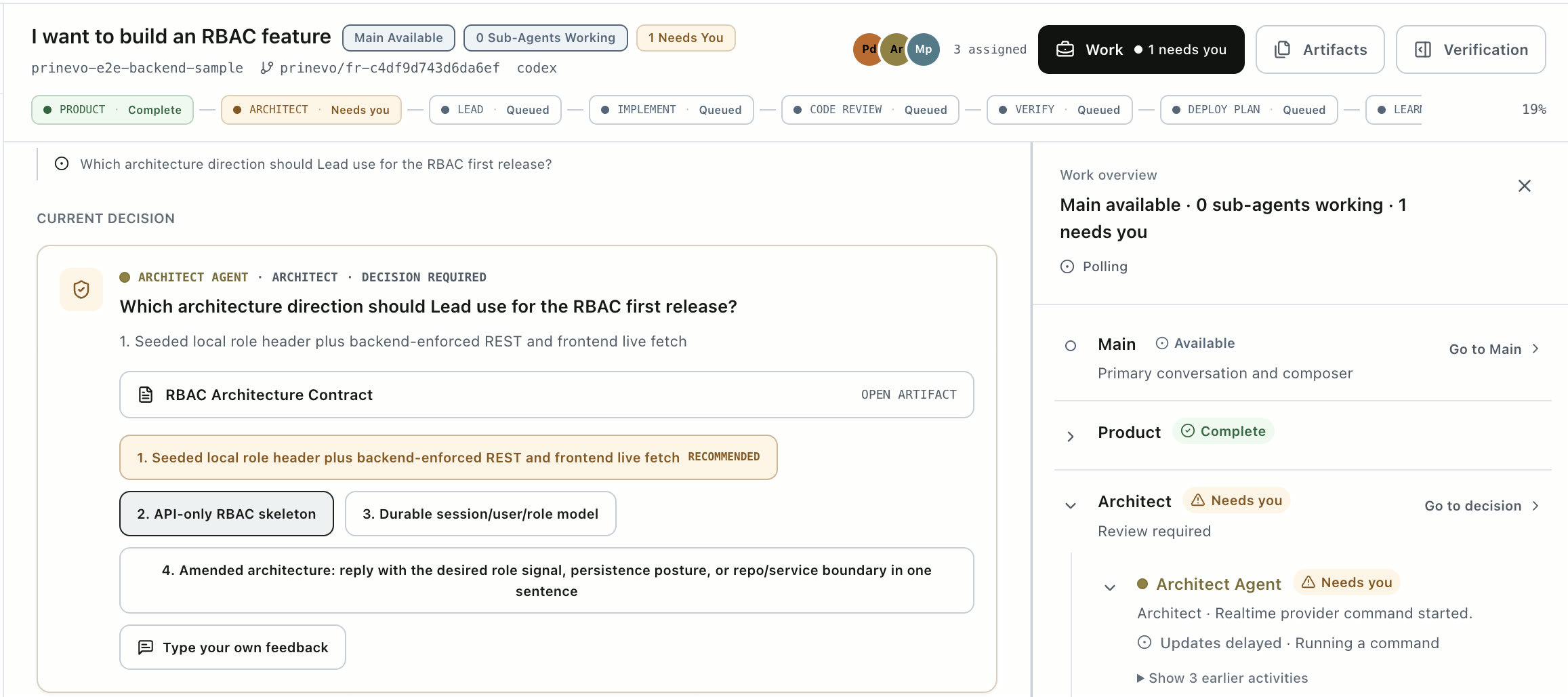
Prinevo full-lane screenshot from a separate RBAC sample run. It is not the trial-to-paid feature in this article.
Call an individual agent when you already know the job
Sometimes you do not need a feature run. You may already have a PR and want the Code Review agent to inspect it. You may want the Verify agent to run QA against a selected PR. Or you may ask a Product or Architect agent to work on a bounded artifact before deciding whether to start implementation.
That direct call should still have a work packet: the request, relevant context, code or artifact revision, allowed tools, expected output, and an accountable owner. The result should join the same visible record when it becomes part of a larger change. Calling one agent is an entry point, not an excuse to lose provenance or skip the checks appropriate to its output.
Governance: people set the limits and can see the work
Governance is part of the run, not a policy document read after it. The organization decides which agent can access which repository, tools, and environments; which model and budget fit the job; and which actions require approval. An Architect agent may need to read system decisions. An Implement agent needs scoped write access. A Verify agent needs a sandbox. A production release request belongs behind the team’s release authority.
Users should be able to see the plan, stage owner, current artifact, blocker, approval, review finding, and verification result in one shared record. An owner can nudge, approve, retry, or redirect meaningful work while it is in flight. A gate should apply to a specific revision; if the underlying contract or plan materially changes, an earlier approval should not silently cover the new version.
This lets low-risk work run with fewer interruptions while keeping human judgment where product direction, architecture, security, or release risk calls for it. The Prinevo product page describes these controls as scoped access, configurable gates, model and cost policy, and an audit trail.
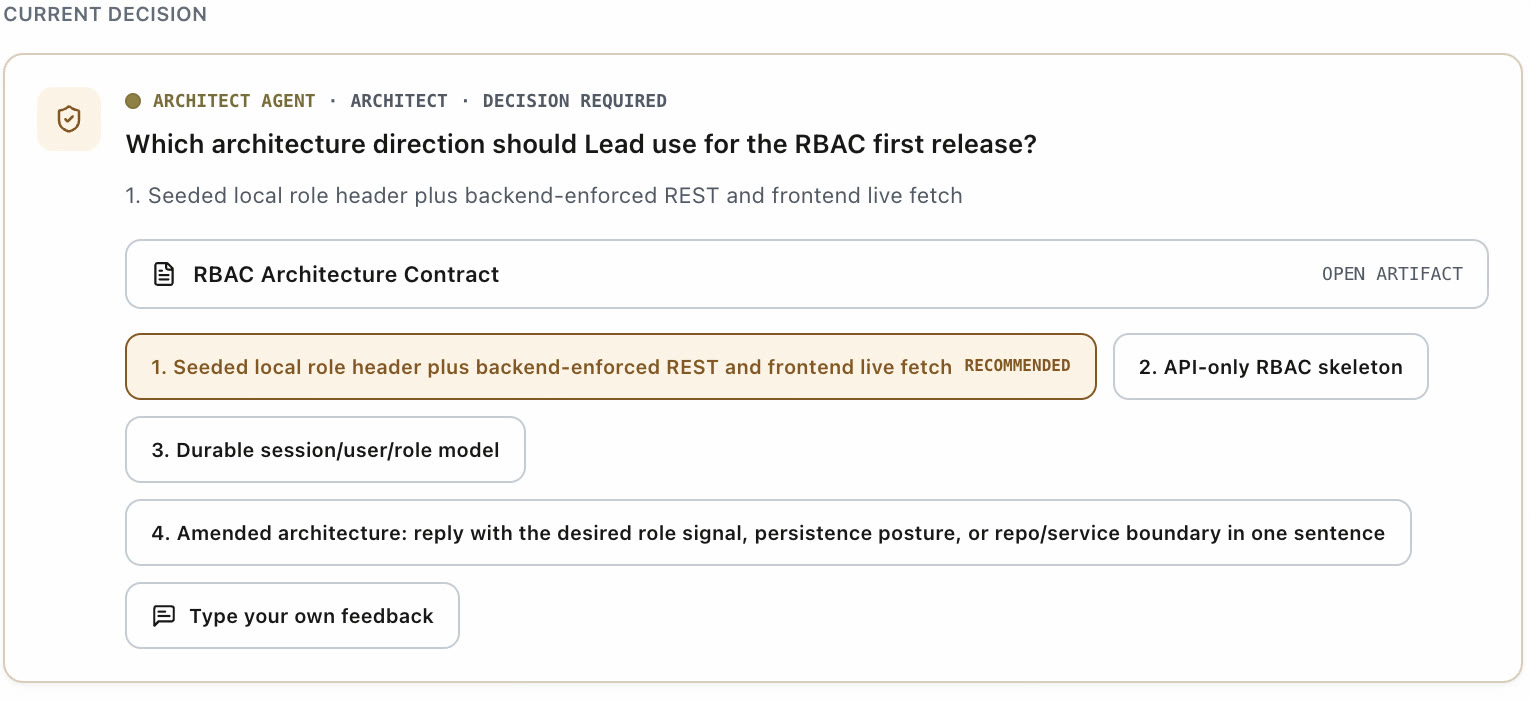
Architecture decision in a separate RBAC sample run. The owner can steer the design before implementation; the options shown are not recommendations for every feature.
Agents can send work back, more than once
Software delivery rarely moves in a straight line. The Code Review agent may find that an implementation violates a repository convention or changes an API contract without updating its consumer. It sends a concrete finding to the Implement agent. The Implement agent fixes the issue and returns a new revision. Code Review checks that revision again. The loop may repeat until the finding is resolved or an owner makes a decision.
Verification has its own return loop. Suppose the individual repository tests pass, but a sandbox contract check shows that the billing worker expects createdAt while the API emits created_at. The Verify agent records the failing check, the environment, and the revision. It sends the issue back for implementation. After the fix, Verify reruns the failed check and any affected flows against the new revision. A screenshot or green test from the earlier revision is not proof for the later one.
I described that field mismatch in an earlier account of a multi-repo change. Here it illustrates the workflow; this article is not claiming a new Prinevo run or reproducing its original test artifacts.
The orchestration layer keeps these exchanges from becoming disconnected agent chats. If work is blocked or a run fails, that state remains visible with a next action. I wrote about this coordination boundary in more detail here.
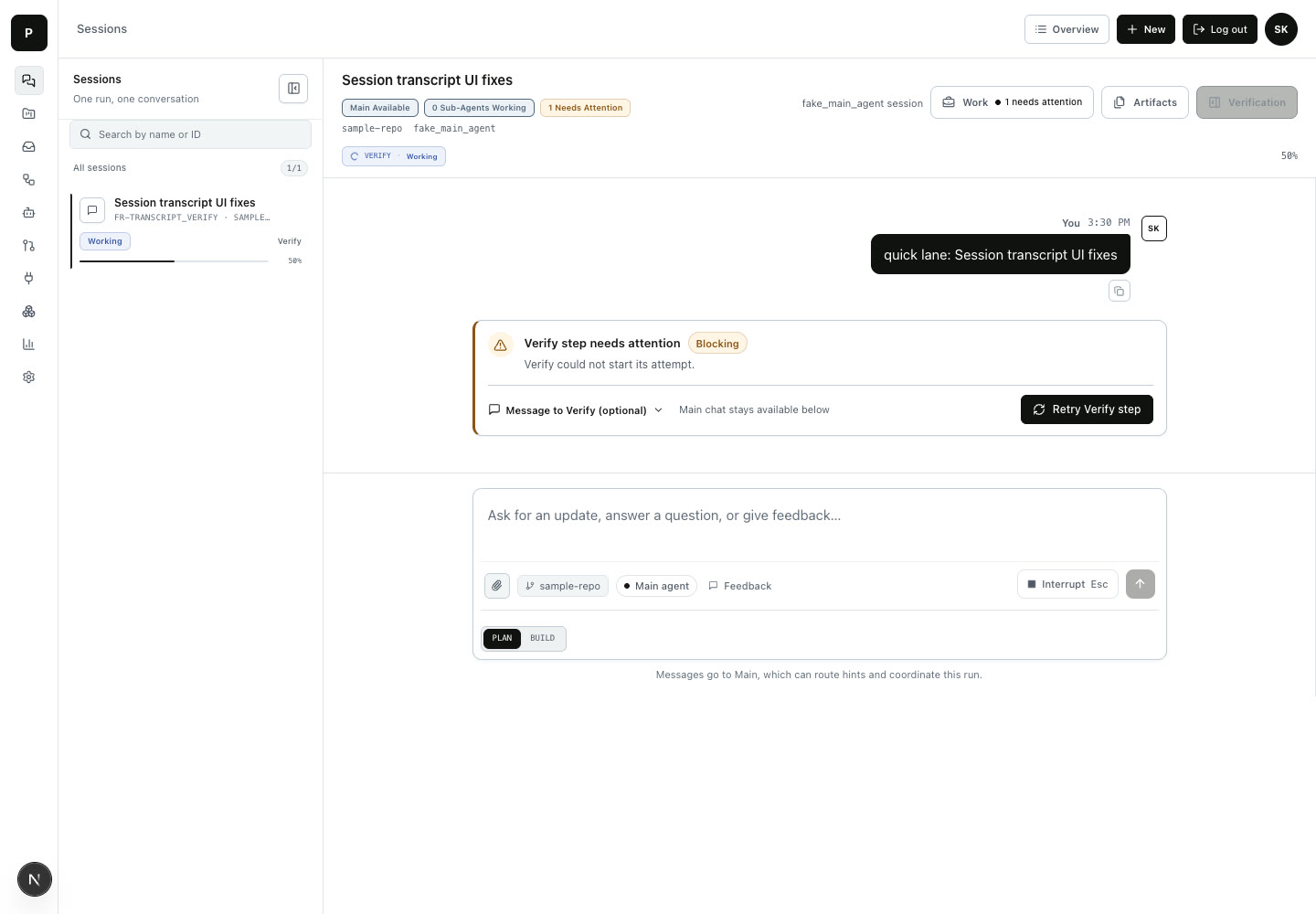
Verify recovery in a separate sample session. A blocked check remains visible and can be retried after the issue is addressed.
What verification actually verifies
Verification is not just “tests passed.” The Verify agent starts from the accepted requirement and the change’s impact. It asks what behavior needs to hold, which consumers or services could break, and which checks can establish that under the available sandbox conditions.
For the trial-to-paid example, that could include a focused entitlement-rule test, an API contract check, an integration test with the billing worker, and a browser flow confirming the customer sees paid access. The agent brings up the relevant services with suitable test data, runs the selected checks, inspects failures and logs, and captures API responses or screenshots when they help a reviewer understand the result.
The evidence package should say what was checked, why it was selected, which code revisions and environment were used, what failed, what was fixed, what passed on rerun, and what remains unverified. That gives the human reviewer something assessable. A sandbox pass proves the recorded scenarios under recorded conditions. It does not by itself prove the feature will behave correctly with production data and traffic.
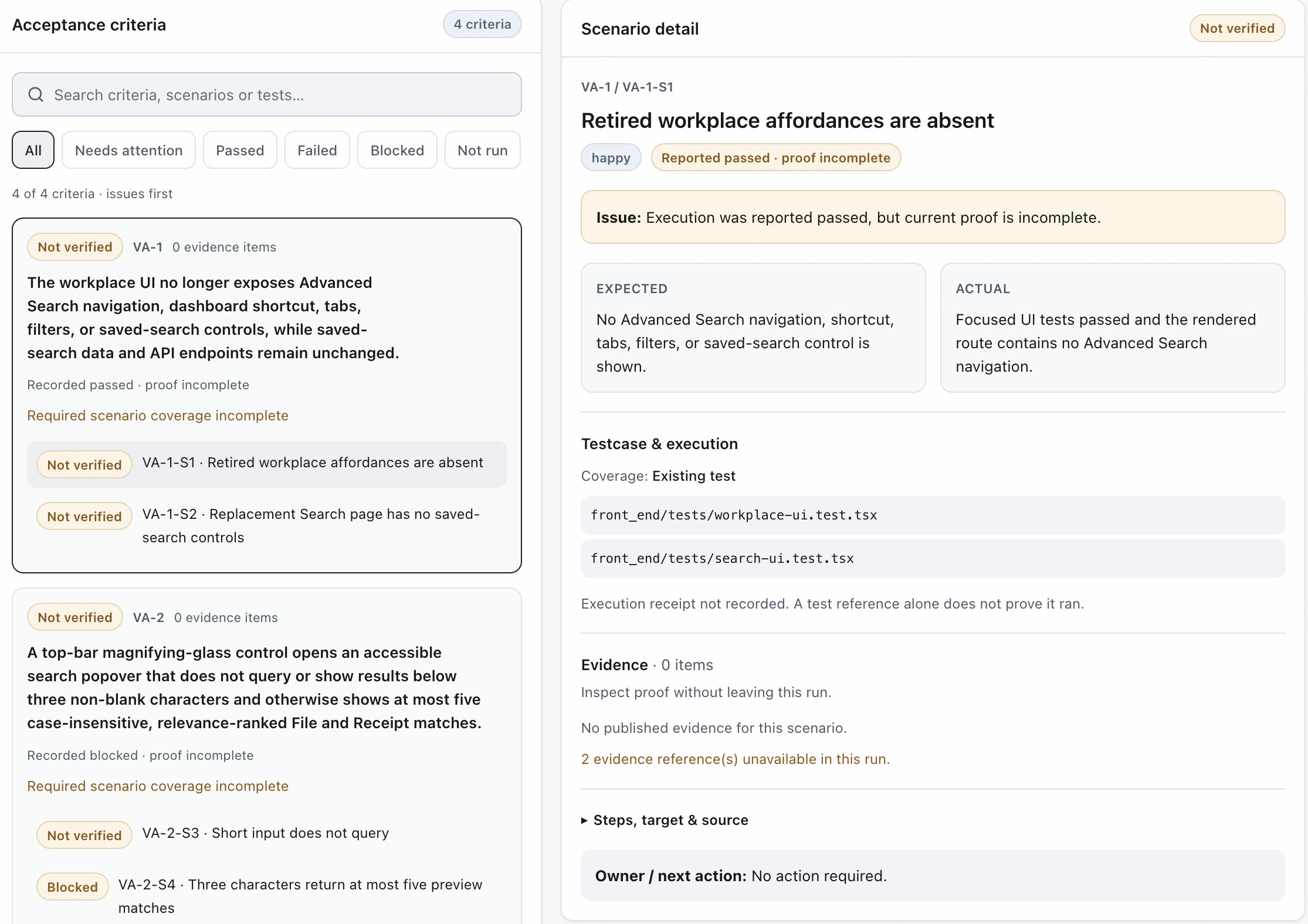
Verification view from a separate sample run. It shows why a reported pass is not verified when required evidence is missing; it is not a result from the feature discussed here.
From a verified change to production delivery
After review and sandbox verification, release planning connects the change to the production system. For the trial-to-paid feature, the team may need to decide which service deploys first, whether old and new versions can coexist, what happens to accounts already mid-trial, which flag controls exposure, and which monitor would show a failed entitlement update. A rollback plan needs to account for data and contract compatibility, not just reverting a commit.
Prinevo’s published model includes a Deploy Plan agent for release order, operational checks, monitoring, and rollback. The team can inspect that plan alongside the code and verification evidence. An authorized person or approved release process decides whether and how to deploy. Once the change reaches production, the team checks the deployed revision and the agreed smoke tests and monitors. A green sandbox run is useful input to that decision, not a substitute for it.
That gives “delivered” a precise meaning. A verified PR is ready for review. A merged PR is in the codebase. A production-delivered change has been deployed under the team’s controls and checked against the intended behavior in the live environment. They are different milestones, and the run should show which one it reached.
Learning: retain the decision and the result for the next run
At the end, the team should see one connected story: the feature request, approved scope and design where needed, affected repositories, artifact versions, agent and human decisions, review iterations, verification results, release decision, and production checks if deployment occurred. If the run stops at a verified PR, the record should say that plainly.
After the run, an accepted lesson can return to shared context. A corrected contract may become a regression check; a missing setup step may become a reusable skill; repeated review feedback may suggest an earlier gate. A production observation may change the rollout instructions for the next feature. Those updates should have a source and owner and be reviewed before they become shared context. The model does not need to retrain itself for the delivery system to learn.
This is the practical test of Prinevo: take one change your team would normally coordinate by hand. See whether context followed the work, whether the right owners could steer it, whether agents resolved review and verification findings, and whether the release owner had the plan and evidence needed to take it toward production. Then check whether the useful lessons would be available to the next run.