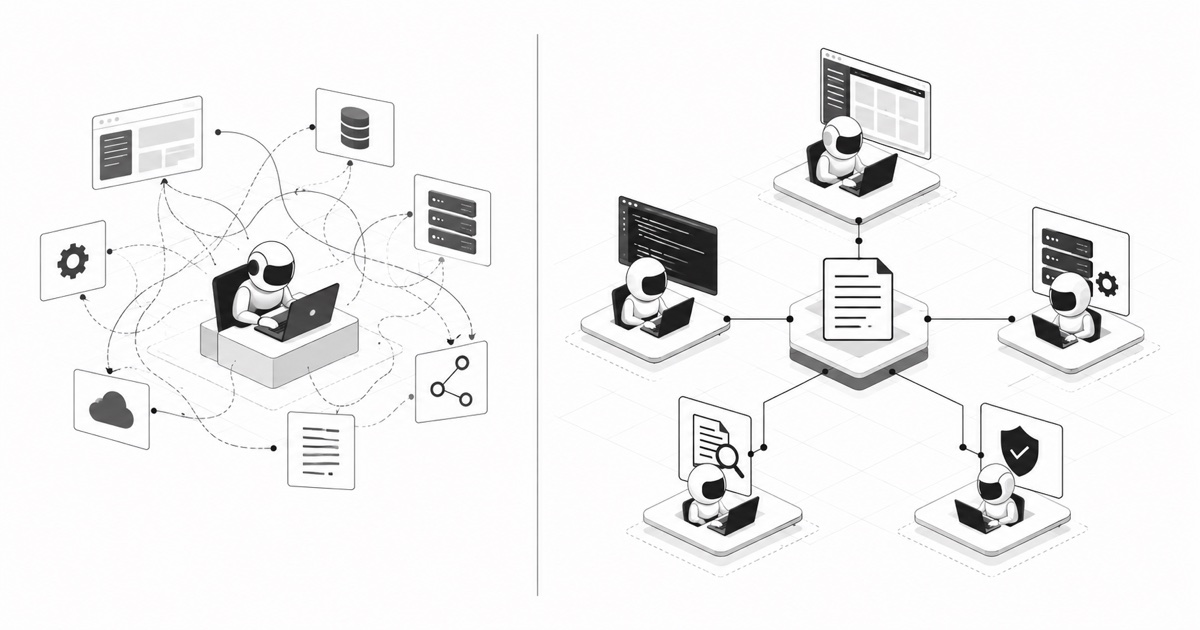
A coding agent can write the code in one repository. Shipping a feature across teams takes shared context, agents that work together, and verification of the whole change.
One coding agent can do a good job on a bounded task. Ask it to fix a component, add a test, or make a small UI change, and the result can be useful. But a feature that crosses the frontend, API, and worker will not ship reliably just because one agent writes code quickly.
It needs product decisions, service contracts, owners, rollout assumptions, and checks across the affected system. A single agent rarely holds all of that context. Splitting the work across several separate agents can help with implementation, but it creates another problem. When one agent changes an assumption or finds a failure, how do the others learn about it?
If the answer is that a senior engineer copies messages between chats and reconciles the PRs, the team still has a coordination bottleneck. The agents are producing code, but they are not working as a team.
A local win can become an integration failure
Consider an illustrative change to project access. A customer admin should be able to change a member from viewer to editor, see the new role immediately, and have the change recorded in the audit trail.
The UI agent adds the control and expects the API to return role: "editor". The API agent changes the permission check but assumes the existing response remains unchanged. The worker agent adds an audit event based on a field name from an older schema. Each agent finishes its own code. The feature fails because they never agreed on the contract between them.
The reviewer now has to reconstruct the missing conversation. Was the response contract approved? Does the permission change take effect before the audit event is emitted? What happens if the worker is delayed? Which repository owns the compatibility check?
This is where parallel agents can increase coordination work. Faster local implementation does not remove the cross-repository decisions.
More agents do not automatically mean one team
The next step is often to assign one agent to each repository. That can speed up local work. It does not ensure that they share the approved behavior or know when a contract changes.
For the access change, the agents need a common record of the expected behavior, affected repositories, API and event contracts, service owners, and the decision about when the new role becomes effective. The UI agent needs the approved response contract. The worker agent needs the event schema and delivery expectations. Both need to know if either contract changes while they work.
Shared context does not mean pasting every document into every prompt. It means each agent can reach the same approved decisions and the current version of the contracts relevant to its responsibility. If an agent finds a new dependency, that finding becomes visible to the right owner before more code is built on an outdated assumption.
Agents need to pass work back and forth
Working together means more than running several agents at once. The frontend agent may need an API decision before it can finish. The API agent may discover a worker dependency. Code Review may send an issue back to Implement. Verify may find a failure that requires another implementation pass. The agents need to exchange these findings without losing the original requirement.
An API agent finishing the permission change should leave the updated contract, code revision, checks it ran, open questions, and the next action it recommends. If it changed role to accessLevel, the UI agent should receive that contract change before continuing. A message saying “API work done” gives the next agent too little to act on.
That exchange needs more than chat. The next agent needs to know what changed, which revision it is looking at, what was checked, what remains open, and whether a human decision is pending. A useful handoff lets another owner continue the work without reconstructing the conversation.
If the API agent discovers that the worker’s event needs a migration, it should pass that finding to the right owner. The team needs a way to connect the finding to the feature, decide whether the new work is in scope, and update the other agents before they continue.
Let review and verification send work back
Coordination is not a straight line from plan to PR. A code reviewer may find that the permission check still allows an old role in one path. A verifier may bring up the affected services, change a role in the browser, and find that the UI shows editor while the API still enforces viewer permissions.
Those findings should return to the implementation owner with the failing behavior, environment, code revision, and evidence. After the fix, the relevant checks run again on the new revision. If a product decision is missing, the accountable human owner answers it. The agents can loop without losing the reason for the correction or claiming that an earlier green check verifies later code.
This is how agents begin to work as a team. They share the decisions that affect the change, pass findings to the next owner, and return failures for correction. People still steer product and technical choices that need an accountable decision. After the run, reviewed decisions and recurring failures can become useful context for the next change.
What to check in your own agent workflow
Take one recent change that crossed two or more repositories. Ask whether every agent started from the same approved behavior and current contract. Check what each agent handed to the next owner, what happened when an assumption changed, and whether verification tested the integrated behavior on the final revision. Count the times a person had to relay information between agents or repeat a decision.
If those answers live only across separate chats and PR comments, the agents are still working in silos. More agent sessions will produce more local output, but the delivery problem remains.
This is the problem Prinevo is built around. It brings multiple specialist agents onto one platform with shared context for the change. Agents can pass work between implementation, review, and verification, with an accountable owner at each stage and evidence a reviewer can inspect.
For the mechanism, see how Prinevo takes a feature request to production delivery.