Maybe not.
Your existing setup can be enough if it carries the accepted requirement through the affected repositories, meaningful verification and a clear reviewer handoff. Look at where people still have to reconstruct context, pass findings between tools or work out whether the combined change was actually checked. That is the work to evaluate before adding anything else.
I would start with one change your team already finds difficult to deliver.
Follow one change through your current setup
Consider an illustrative trial-to-paid feature. The frontend shows the account’s new state, an API enforces the entitlement and a billing worker processes an event.
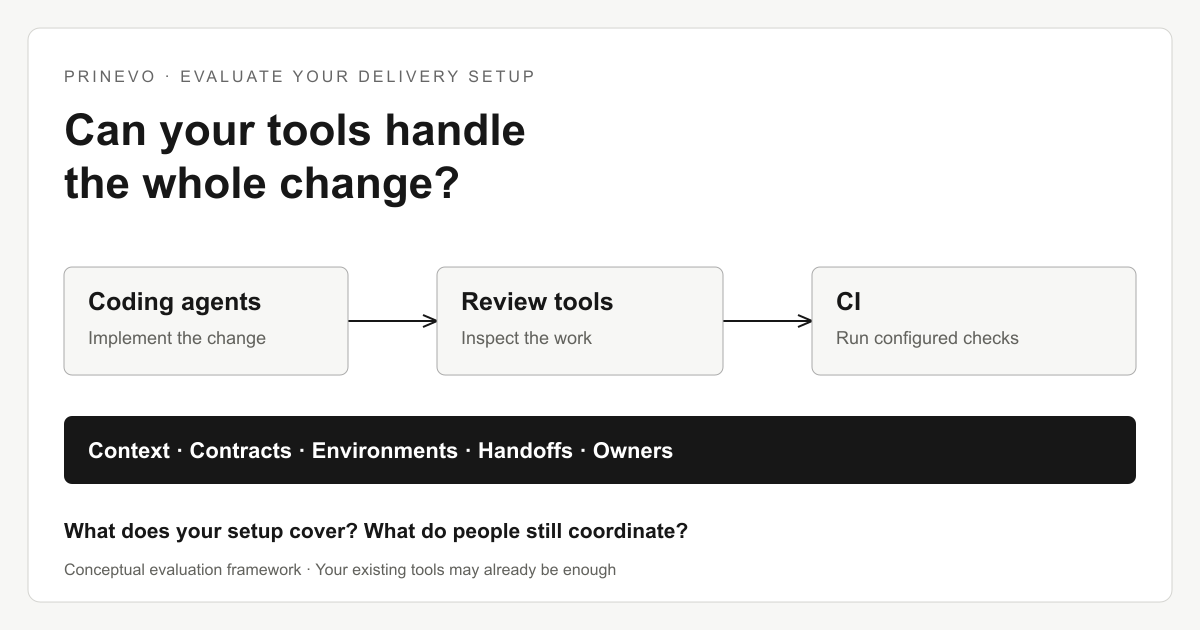
The coding agent makes the changes. The review tool checks them. CI runs the configured tests.
Now ask what those checks established.
Did the API and worker agree on the event? Were the relevant service revisions tested together? What happens to an account already in a trial? If verification fails, does the finding return to implementation with enough context to fix it?
Your current tools may already support this. Inspect the actual workflow. If an engineer has to discover the missing consumer, copy the failure into another session and collect the evidence afterward, count that work too.
The change impact guide gives you a way to connect affected behavior to the checks it needs.
When the existing setup is enough
For a small change in one repository, clear requirements, working tests and an accountable reviewer may cover what you need.
A larger team may also have an internal platform that already provides shared context, repeatable environments, access controls and coordinated checks across services. Adding agents to that setup can be a reasonable choice.
I would keep it when engineers can explain what was checked, recover from a failed run and hand over the evidence without repeatedly rebuilding the workflow.
You do not need a software factory just because you use several agents.
When a shared delivery layer is worth evaluating
The case gets stronger when the same coordination work keeps falling on your senior engineers.
Someone repeatedly explains the architecture. Someone tracks which contract changed. Someone gets the services running, routes review findings back to the right agent and checks that the rerun used the corrected revision.
These responsibilities need an owner whether you connect the tools yourself or use a platform.
| If your team already has this | If it is still recurring manual work |
|---|---|
| Current requirements, contracts and owners reach the relevant agents | Engineers reconstruct the same context across sessions |
| Findings return to implementation and trigger the right rerun | Review comments get copied between chats and PRs |
| Services, fixtures and compatible revisions can be tested together | Someone repairs or assembles verification for each change |
| Reviewers receive results and explicit gaps | Reviewers have to discover what was never checked |
Use the right-hand column to identify the gap you want to solve. It may need a small integration, a better sandbox or a change in team responsibility. A shared platform becomes worth evaluating when those gaps recur across enough work to justify it.
Compare the work your team will still own
If you build the delivery layer internally, someone needs to maintain integrations, context, environments, permissions and failure recovery as the tools change.
If you buy, ask the provider to demonstrate those responsibilities against your setup. Check supported integrations, access boundaries, evidence and ongoing maintenance. Your team still owns product decisions, domain rules and release approval.
Then compare a representative change using the real-change scorecard. Include setup, human interventions, reviewer rework and blocked attempts alongside time to a verified PR. Keep that endpoint separate from production delivery.
The question I would ask about Prinevo is the same. Can the agent-team workflow reduce the repeated coordination around your existing tools while keeping the work inspectable and your team in control?
Bring one real change to a Prinevo walkthrough. Show us how your team handles it today, including the parts that already work. Use that to decide what you should keep, connect or delegate.