So why would you pay for Prinevo’s QA agent?
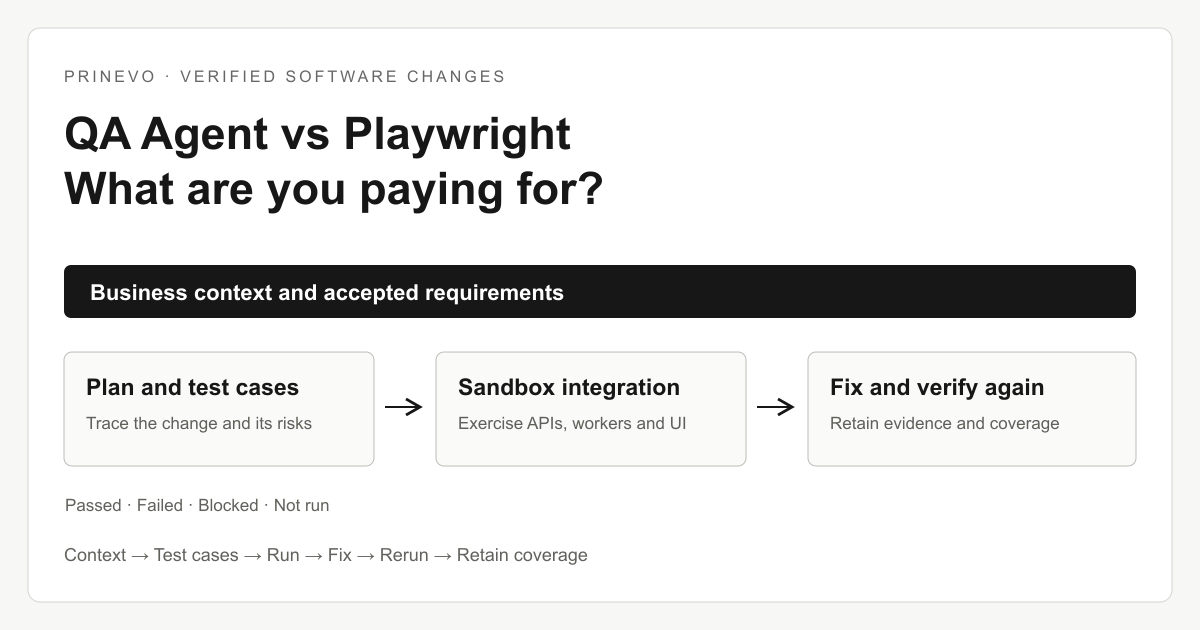
The value is in managing verification around the change. Understand the business requirement, trace what could break, maintain the relevant test cases, run the affected system in a sandbox and carry failures through to a verified correction.
Playwright can be one of the tools inside that workflow. It supports browser and API testing, and has agents for planning, generating and repairing tests. Test generation alone is not enough of a reason to buy another platform. Playwright documentation
Understand what the change means for the business
Consider an illustrative pricing change. Enterprise customers should receive a 20% discount, and checkout and the final invoice should agree.
The QA agent needs more than the edited files.
It needs the accepted pricing rule, the affected API contract, the worker that generates the invoice and the existing behavior for other customer plans.
That context defines the blast radius. A small change in one repository can affect several consumers.
In Prinevo’s workflow, the requirement, architecture decisions and affected repositories stay connected to implementation and verification. If the intended behavior is unclear, the accountable owner needs to resolve it before the agent turns an assumption into a passing test.
The context layer gives QA a common baseline
The QA agent needs to understand how your business works, not just how someone clicks through the application.
Who can change a price? Which customers qualify for the discount? Should an existing invoice keep its original amount when the pricing rule changes?
Prinevo’s context layer brings together the relevant domain rules, architecture, service contracts, accepted decisions and previous failures. QA uses that context to identify scenarios and downstream risks that the edited code alone may not reveal.
Implementation, Code Review and QA work from the same accepted requirements and contract revisions. They still check the result independently. Shared context should prevent conflicting assumptions, not make agents agree on an incorrect implementation.
When a business rule is missing or contradictory, the responsible human owner resolves it. The agent should surface the question rather than invent the expected result.
Manage test cases through the change
Writing another test is only one part of the work.
The QA workflow needs to inspect existing coverage, identify missing scenarios and decide which tests to keep, add or update. Expected results must follow the agreed behavior.
For the pricing change, a focused calculation test may catch the wrong discount quickly. An integration test checks that the API and invoice worker agree. A browser test checks what the customer sees.
These checks serve different purposes. The fastest useful feedback may come from a small test rather than a complete browser journey.
Prinevo’s test-case lifecycle also accounts for what survives the run. Reusable checks belong in the appropriate repository so future changes can run them again. A screenshot from today’s session is evidence, but it is not a regression test.
Exercise the actual integration in a sandbox
The sandbox needs the relevant services, compatible code revisions, configuration and test data.
For this example, QA should exercise the API, follow the event into the worker and inspect the resulting invoice. If a dependency is mocked or unavailable, that limitation belongs in the result.
A green checkout screen does not establish that the invoice is correct.
Prinevo’s verification sandbox workflow connects those checks to the running system.
Close the loop with the implementing agent
Suppose checkout is correct but the invoice uses the old discount.
QA needs to send implementation a reproducible failure, the expected result and supporting evidence. After the fix, the relevant checks run against the new revision.
The reviewer should see what was tested, what failed, what changed and what remains unverified.
Useful lessons can also carry forward into setup instructions, retained context or verification rules through the learning workflow. Corrections should not disappear into a chat that the next run never sees.
Evaluate the complete workflow
The buying question is how much work your team still does between these steps.
Compare environment preparation, test maintenance, failure investigation, correction cycles and human review. Include time spent correcting the agent.
Put this into practice with Prinevo
Evaluate the complete workflow
Prinevo’s case is strongest when that connected workflow reduces coordination work and produces evidence the team can inspect. Full-suite CI, human judgment and production release checks still have their own responsibilities.
Evaluate Prinevo’s QA and implementation workflow on one representative change