Adding another coding agent will not help that queue.
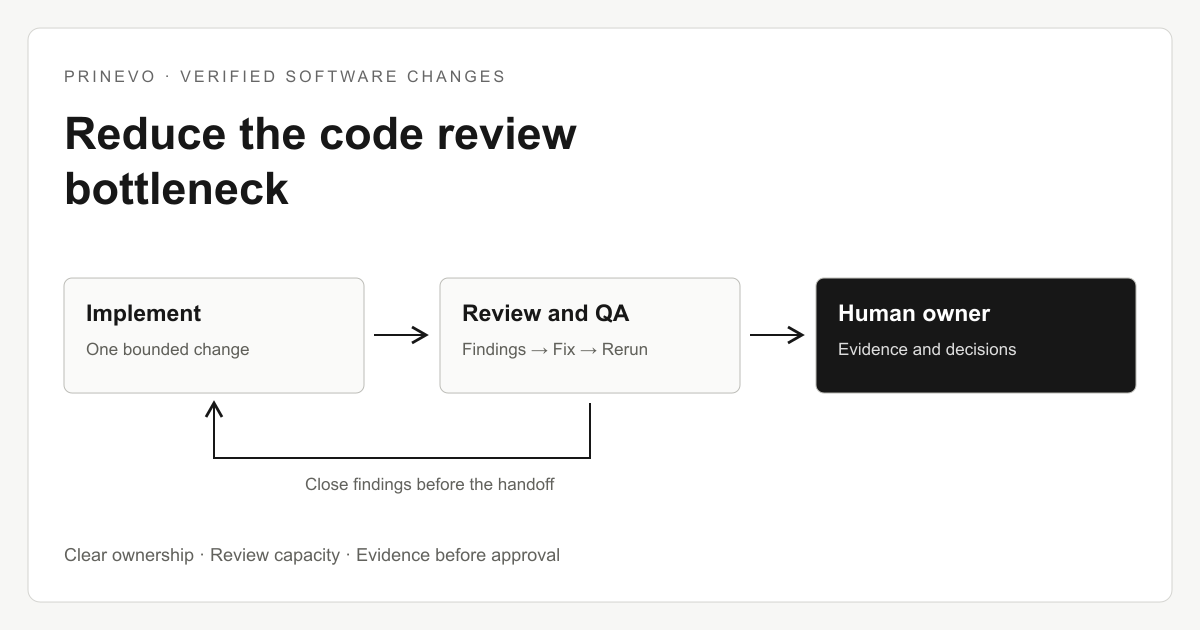
To reduce the code review bottleneck, define what a change needs before human handoff, use review and QA agents to resolve findings, route the remaining decisions to accountable owners, and limit new work when review capacity is full. Keep the amount of checking proportional to the risk. A copy change and a billing migration should not need the same path.
I would start by looking at what the reviewer is actually doing. Reading the code? Finding the requirement? Starting the app? Asking whether anyone checked the worker? Those are different kinds of work, even if they all appear under code review.
Find what is holding the change up
Take a few recent PRs and follow them from implementation to merge. Record when the change was ready for assessment, when someone picked it up, and what happened after that.
| What holds the PR up | What to change first |
|---|---|
| Nobody qualified has time to review it | Allocate review capacity and limit work waiting for that owner |
| The reviewer has to reconstruct the requirement | Carry accepted behavior and decisions into the PR |
| The change mixes a feature, refactor and unrelated cleanup | Separate work into understandable units with explicit dependencies |
| The reviewer is the first person to run the feature | Run the relevant behavior and retain the evidence before handoff |
| Comments repeatedly expose the same convention violation | Add a reviewed rule, focused check or review skill |
| A product or architecture decision is unresolved | Get that decision from its owner before continuing implementation |
A better test report will not make an unavailable billing owner available. More reviewers will not repair an environment that nobody can start. Diagnose the queue before adding another tool.
Make the author responsible for the handoff
An engineer who submits agent-written code still needs to understand the change they are asking someone to approve. The implementation agent should also leave a clear account of the work, rather than a chat history the reviewer has to search.
Consider an illustrative change to account trial status. It touches the API, a frontend banner and a billing worker. Three locally reasonable changes can still disagree about when a trial ends.
Before implementation fans out, agree the behavior and the shared contract. Which timestamp defines the end? Which component is authoritative? What should the customer see while the worker is delayed?
If the team has not agreed those answers, review will become the place where the requirement is finally written. I would put the accountable product or domain owner there earlier. Use a gate when the decision matters, rather than requiring every small change to go through a full design ceremony.
Then give each implementation owner a bounded part of the change. Keep the related PRs linked so a reviewer can see their combined effect and deployment dependencies. Smaller diffs help only when the pieces still make sense together.
GitHub’s engineering interviews on code review describe teams using AI for an initial review while keeping changes small and retaining human responsibility. They also warn that little feedback from an AI reviewer can be mistaken for comprehensive validation.
Give review and QA different jobs
A review agent should inspect the implementation against the requirement, architecture, contracts and team conventions. A QA agent should exercise the expected behavior in an identified environment and report what happened. Their findings can overlap, but the jobs are different.
For the trial change, the review agent might find two components calculating the expiry differently. QA might find that the banner updates correctly but the worker still applies the old rule.
Both findings belong with the implementation owner. They should include the affected revision, expected behavior, observed problem, evidence and the decision or correction needed.
The loop should look like this.
Accepted behavior and bounded implementation
    → Code review and QA checks
    → Findings returned to the implementation owner
    → Corrected revision
    → Relevant checks repeated
    → Remaining decisions and evidence handed to the human owner
This can happen more than once. A code reviewer can reject the revised implementation again. QA can find a second failure after the first fix. Keep the findings and their resolution visible rather than replacing every previous report with a final green result.
Some review and QA work can run in parallel on a recorded revision. A later code change still needs the affected checks repeated. For a tightly coupled change, resolve the contract review before spending time on a full integration run.
Set limits too. If the agents disagree about the requirement, or cannot reproduce a failure, escalate with the evidence. Repeating the same attempt indefinitely creates another queue.
Decide what ready for human review means
I would use a short handoff record rather than a long generated essay.
- The accepted requirement and the behavior that changed.
- The affected components, related PRs and rollout assumptions.
- The tested revisions, environment and selected checks.
- Findings, fixes and the results on the corrected revision.
- Checks that failed, were blocked or did not run.
- The decisions still needing the named reviewer.
For the trial feature, that means showing the same account through the API, banner and worker flow. If the worker could not start, say that the integration check is blocked. A screenshot of the banner cannot close the worker question.
An incomplete change may still need an early human decision. Send it as that specific request, with the blocker visible. Do not label it ready for final approval.
The verification sandbox guide explains how to make those checks repeatable. The handoff should let a reviewer inspect the result without rebuilding the investigation.
Match incoming work to review capacity
Even a well-prepared change needs someone to assess it. If agent work arrives faster than qualified owners can process it, the waiting list will grow unless the team changes capacity, scope or intake.
Give review time an explicit place in the team’s work. Route changes to owners who understand the affected domain. Develop additional ownership through paired reviews where appropriate, rather than granting approval rights without the underlying context.
When the queue is full, put agents and engineers on closing findings, reproducing failures and preparing existing changes. Do not keep starting work simply because code generation is available.
The limit depends on your team and risk. I would watch waiting time and unfinished work rather than impose one PR-count rule on every repository. A small text fix and a coordinated migration consume different review capacity.
Check that the work reduced rather than moved
Track time waiting for a reviewer separately from active review time. Also record human time spent clarifying requirements, repairing the environment, reproducing results and fixing issues found after handoff.
Keep defects and rework beside the throughput measure. A faster merge is not an improvement if the team spends the next day repairing it. Compare similar changes and include blocked or abandoned attempts.
This is the delivery model we describe in Prinevo’s workflow. Each stage has an accountable owner, agents can return work for correction, and people steer the decisions that need judgment.
Start with one recent PR that waited too long. Identify what the reviewer had to reconstruct, then decide which part should be done before the next handoff. Use the real-change evaluation scorecard to check whether that change reduces human effort and reviewer rework.