Faster coding agents can help an engineering team deliver faster when the saved implementation work carries through to completed changes. To assess that, count the human effort and waiting across the delivery path, then check whether rework or defects have increased. More code and more opened PRs alone cannot answer the question.
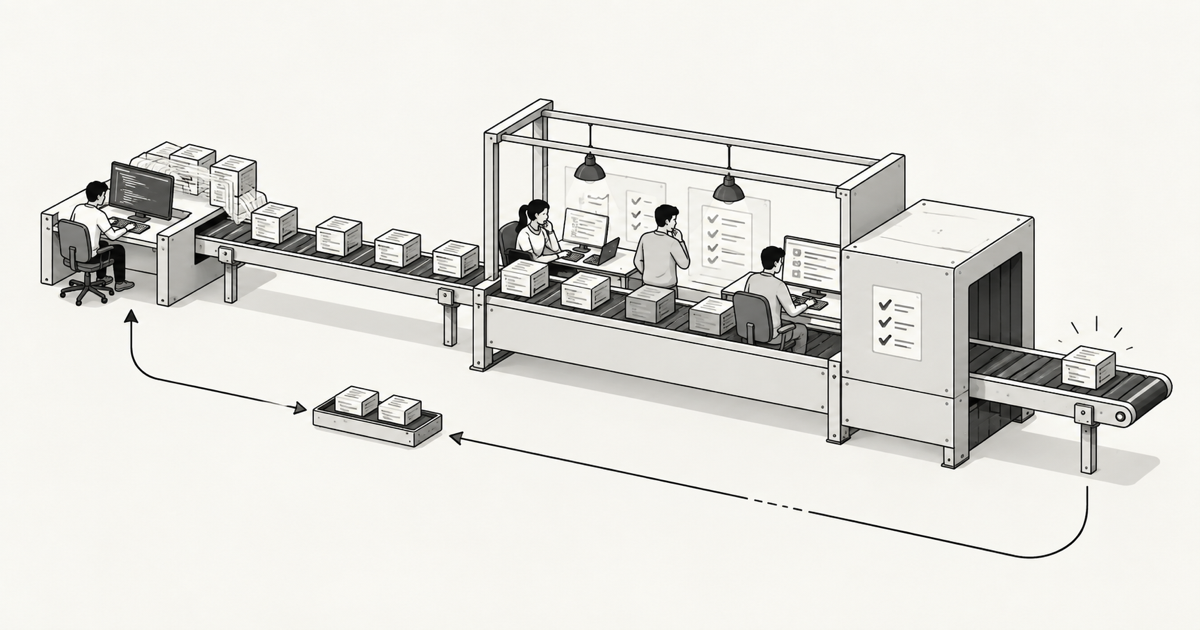
An engineer finishes implementation quickly. The PR waits for review. The reviewer finds an unclear requirement, QA needs help bringing up a service, and a consumer breaks when the change is tested across repositories.
The coding was faster. What happened to the rest of the work?
That is the question I would ask before calling the team more productive. The local gain can be useful. We still need to understand whether it reduced the effort to deliver something the team can trust, increased useful output with the same effort, or moved work to someone else.
A discussion in r/EngineeringManagers asks this directly. If one engineer produces changes faster, where does that output land in review, QA, integration, or another team?
Decide what you mean by faster
A PR opened, a verified PR, a merged change, and a change available to customers are different endpoints.
If you measure only the time to an opened PR, you leave review, verification, integration, and release outside the result. That may be a useful implementation measure. It is not enough to describe the team’s delivery performance.
For a coding-agent pilot, a verified PR can be a practical endpoint. The requested behavior is clear, relevant checks have run, and the reviewer receives evidence tied to the tested revisions and environment. Our real-change evaluation scorecard uses that boundary.
For team throughput, define the completed unit and the period you are counting. Are you looking at verified changes ready for review, or changes delivered to production? Keep the distinction visible.
Also separate throughput from lead time. Throughput counts completed units over a period. Lead time follows how long a change takes from an agreed start to its endpoint. Track both, with enough detail about the work to make the comparison useful.
A copy change, a migration, and a feature crossing several services should not become interchangeable productivity units just because each has a ticket.
Follow one change beyond implementation
Consider an illustrative feature that gives a customer access to a paid capability after upgrading their subscription. It touches the upgrade UI, an entitlement API, and a billing-event consumer.
An implementation agent updates the API and writes tests. The frontend agent updates the upgrade flow. Both produce plausible changes.
The reviewer then asks what should happen when the billing event arrives late. The requirement does not say. The product owner needs to decide, and implementation pauses while that decision is resolved.
Later, QA starts the integrated flow. The test account is missing the state needed to exercise the upgrade. An engineer repairs the seed routine. Once the scenario runs, QA finds that the API and consumer disagree about an event field. The affected implementation is fixed and checked again.
Each of these is work needed to deliver the feature. A faster implementation step does not make it disappear.
The questions to ask are concrete.
- Could the delayed-event behavior have been settled before implementation?
- Could the agent start the required services and prepare the test account itself?
- Could a contract check expose the field mismatch earlier?
- Did the reviewer receive the requirement, impact, and verification evidence, or have to reconstruct them?
In my April essay, I described a service emitting created_at while its consumer expected createdAt. The repositories passed their own tests, and an integration check caught the mismatch in the sandbox. That earlier account is the small version of this problem. The boundary still needs checking even when both sides of the code look reasonable.
Count the human work around the agent
Start with the people who touched the change.
Who clarified the requirement? Who supplied the missing context? Who granted access, repaired the environment, reviewed the diff, investigated a failed check, or explained a decision again?
If those activities happen outside the agent session, they still belong in the accounting.
Record active human effort separately from elapsed time. A change might wait for a reviewer without anyone actively working on it. Another change might move through quickly while several people spend time fixing it. These are different problems.
Concurrent work matters too. Do not add every person’s working time and call that elapsed lead time. Keep the two records separate, and avoid counting the same intervention twice when several systems log it.
This also answers a different question from whether someone’s workload feels smaller. A team can deliver more with the same working hours. Or it can hold output steady and reduce effort. Increased demand can absorb saved capacity. Establish which outcome you are evaluating before interpreting the result.
Token usage and tool spend help explain resource use and cost. They do not establish that the team delivered a useful change. A manager’s question about ranking engineers on AI usage exposes how easily adoption activity can become the target. I would use this analysis to improve the workflow, with engineering judgment about the work and its value.
Put quality beside the throughput number
More completed changes are useful only if the team can stand behind what it delivers.
Look at what happened after the agent reported completion. How much implementation had to change during review? Which verification checks failed? What remained untested? Did a defect appear after release, and what work did it create?
Keep the definitions stable. First-pass verification and eventual verification answer different questions. A final pass can follow several expensive correction rounds. Reviewer rework can include a genuine defect, a missed requirement, or missing evidence that made the result hard to assess. Label those causes.
Track defects after release over an agreed observation period, with their severity and impact. A recently shipped change has had less time to reveal problems than an older one. No reported defect yet is a limited observation, not proof that the change is correct.
Also inspect whether the tests check accepted behavior. If an agent writes the code and the tests from the same wrong assumption, green checks may confirm that assumption. Requirements, contracts, and known regressions provide a reference outside it.
Finally, ask whether the change solved the intended problem. Delivered volume and technical quality matter, but they do not establish that customers needed the feature. Keep the product outcome visible alongside the delivery measures.
Improve the part of the workflow that is holding work up
If review is waiting on missing context, starting more implementation agents may add to the queue. If the agent cannot run the app, adding another reviewer does not repair the environment.
Use the observed problem to choose the intervention.
| What you observe | A useful change to try | What to inspect afterward |
|---|---|---|
| Repeated clarification after coding starts | Settle the material requirement and name its owner earlier | Fewer scope corrections and less repeated explanation |
| PRs wait because the changes are hard to assess | Keep changes coherent and provide impact and evidence before handoff | Review waiting, clarification rounds, and rework |
| QA spends time repairing setup | Make the sandbox, seed data, and startup checks reproducible | Human setup effort and blocked verification attempts |
| Services pass alone but fail together | Check the affected contracts and integrated behavior earlier | When boundary failures are detected and how much rework follows |
| More concurrent work is opened than the team can finish | Limit work in progress and resolve existing blockers | Completed work, queue age, and time spent switching context |
Change something specific and inspect the result. If scope, staffing, models, and workflow all change together, record that. A before-and-after difference does not tell you which change caused it.
Our sandbox setup guide explains the environment work. The parallel coding agents guide covers bounded responsibilities, dependencies, and combined verification. Use the part that addresses the constraint you actually found.
Keep a simple record of the change flow
You can begin with a worksheet attached to the change. Record the event when it happens and link the supporting artifact.
| Event | Record with it |
|---|---|
| Work starts | Request, accepted scope, task type, starting revisions, and agreed endpoint |
| Implementation is ready for review | Output revisions, known gaps, and evidence available at handoff |
| Review starts and findings return | Waiting interval, review effort, finding type, and responsible owner |
| Verification completes or blocks | Tested revisions, environment, checks, results, reruns, and unresolved gaps |
| Change merges and reaches production | Separate merge and deployment events, release decisions, and rollout limitations |
| Follow-up period ends | Observed defects, customer outcome where available, and repair effort |
Log human effort and blockers alongside these events. Work can return to implementation or verification more than once. Keep that history instead of replacing the earlier failure with the final successful result.
Choose work to observe before seeing the outcomes. Compare similar types of changes and account for differences in scope. Include failed, abandoned, blocked, and still-unfinished attempts. A completed-only report can look better while difficult work accumulates elsewhere.
For a team view, track completed work alongside what remains in progress and how long it has been waiting. Do not turn a few successful examples into a company-wide speed claim.
Evaluate the delivery system around the model
I think this is the practical reason to build the system around coding agents. Context helps the agents find the applicable rules. Coordination keeps people and agents aligned. Verification gives them a way to test the change and fix what fails. Governance keeps decisions and access within their allowed boundaries. Reviewed learning gives recurring corrections a place to go.
Those are the responsibilities we are connecting in Prinevo. Our team collaboration guide shows how people contribute and steer work while agents run. Whether that setup improves a particular team’s throughput still needs an evaluation on that team’s work.
Take a small set of representative changes. Define the endpoint, record human effort and waiting, inspect rework, and follow the released result. Use the evaluation scorecard to keep the comparison explicit.
When the next agent produces a PR quickly, ask what happened to the whole change. Did the team finish useful work sooner? Did someone else pick up extra checking and repair? And what would help the next change move through with less effort and the quality you need?