To run multiple coding agents without conflicting changes, agree on the intended behavior and shared contracts, assign bounded work with clear owners, isolate editing workspaces and runtime resources, and track dependencies in shared run state. Bring the outputs together and verify the combined change against the exact revisions. Parallel work helps where tasks can proceed independently. Shared decisions still need an owner.
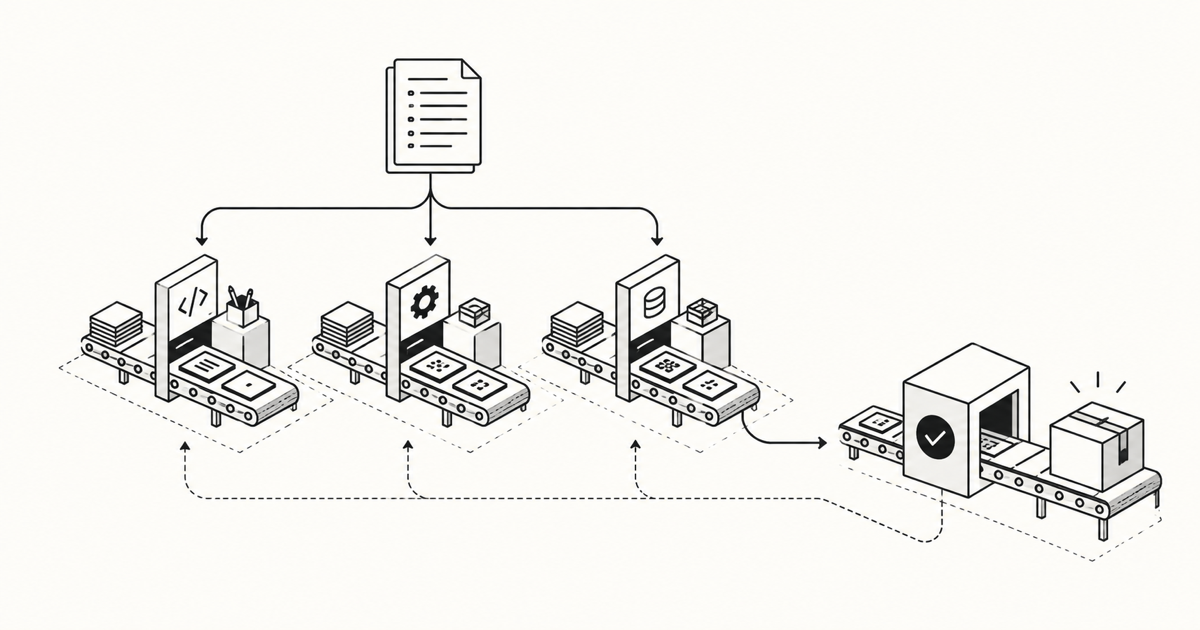
You have one agent working on the frontend, another on the API, and a third on the worker. Each finishes its task. Each says the tests pass.
But did they build the same feature?
The frontend might expect one status value while the worker produces another. Two agents might both update the same generated client. QA might test an earlier API revision while implementation is still changing it.
Now someone has to reconstruct what happened and get the agents aligned again.
I think this is where the coordination work becomes visible. Starting more agents is one part. Keeping their work aligned, handling feedback, and knowing which result is ready for review requires a shared workflow.
Agree on the change before splitting the work
Consider an illustrative feature that lets an admin upload a CSV to import customers. The frontend accepts the file, an API creates an import job, and a worker processes the rows. The admin sees progress and downloads a report of rejected rows.
Before assigning three agents, settle the decisions they all depend on.
Who can start an import? What happens to a duplicate customer? Which job states can the UI display? Where does the rejected-row report live? What does the API return while that report is unavailable?
Give these decisions an accountable owner. For a small change, that might be the engineer steering the work. For a larger change, a Product or Architect owner may need to review the requirement and contract before implementation starts.
Record the accepted behavior and the current contract revision. The frontend, API, and worker tasks should reference those records.
You can begin parallel implementation when the shared decisions are stable enough to work against. If the duplicate-handling rule is still unresolved, do not let each agent quietly choose one.
Split work by responsibility and dependency
Divide the feature into bounded tasks. Give each task an output and a completion condition.
| Work | Accountable owner | Inputs needed before starting | Output for the next stage |
|---|---|---|---|
| Define behavior and contract | Feature owner | Requirement and current system constraints | Accepted rules, job states, request and response shapes |
| Build upload and progress UI | Frontend agent | Accepted contract and UI behavior | Frontend revision and local checks |
| Build job API and authorization | API agent | Accepted contract, ownership, and access rules | API revision and contract checks |
| Build import processing | Worker agent | Job contract and duplicate-handling rule | Worker revision and processing checks |
| Review and integrate | Assigned reviewer and integration owner | Compatible implementation revisions | Findings, resolved conflicts, integrated revisions |
| Verify the feature | Verify agent | Accepted behavior, integrated revisions, runnable sandbox | Results, evidence, and remaining gaps |
Frontend and worker implementation can run in parallel once their inputs are agreed. Verification of the complete flow depends on the participating implementations being available together.
If two agents need to edit the generated client, assign that update to one owner or sequence the edits. If a migration changes the meaning of data another task uses, make that dependency explicit.
For a small fix in one module, one implementation agent followed by review and relevant checks may be enough. Add parallel agents when there is useful work to separate and a way to combine their outputs.
Isolate the workspace and the runtime
Give parallel implementation tasks separate editing workspaces. In one repository, Git worktrees let you check out different branches in separate working directories. Across repositories, record the base revision for each task.
This prevents agents from editing the same working directory. You still need to coordinate changes that touch the same contract or behavior.
Also assign the runtime resources. Two worktrees can still point at the same database, consume the same queue, or try to start a server on the same port.
For the customer-import feature, each task should know which service ports, database or schema, queue, storage location, and test accounts it can use. Scope credentials to that environment. Keep seed and cleanup routines from changing another active task’s data.
Separate runtime resources where independent execution needs them. Where resources must be shared, make access and scheduling explicit.
Check this before launching the agents. Can one task reset its test data without breaking another task’s run?
Share accepted context and route changed decisions
Common context does not mean putting every conversation into every agent’s prompt.
The frontend agent needs the job states and display behavior. The worker agent needs row-processing rules, retry behavior, and the result contract. The API agent needs authorization and the boundary between the request and the queued job.
Each should receive the relevant sources and the same accepted version of the decisions they share. Keep agent definitions and reusable skills versioned too, so the run records which setup was used.
Suppose the worker discovers that imports need a partially_completed state. It should raise the contract question to the responsible owner. After the decision is accepted, identify the affected API, UI, and verification tasks. Update their inputs and pause or supersede work that depends on the old decision.
Do not leave one agent working against the new contract while another continues with the old one.
Our shared engineering context guide explains what to retain outside individual sessions. Coordination also needs to establish when changed context reaches the work already in progress.
Make every handoff explicit
In my writing on multi-agent systems, I have described agents receiving intent, context, and artifacts, then returning their work and proposing what should happen next. The orchestration layer validates that proposal, applies the required gates, persists state, and dispatches the next task.
For this feature, an implementation handoff should contain enough information to inspect and continue the work.
| Handoff field | What it answers |
|---|---|
| Task and attempt | Which piece of work produced this result? |
| Outcome | Completed, blocked, waiting for a decision, or failed? |
| Input versions | Which requirement, contract, base revision, and skill version were used? |
| Output revisions | Which commits or artifacts should the next owner inspect? |
| Checks and evidence | What actually ran, against which revision, and what happened? |
| Open findings | What remains unresolved or could not be checked? |
| Proposed next work | Review, verification, clarification, or another bounded task? |
A status of completed should mean the task met its own completion conditions. It does not automatically mean the whole feature is verified.
Keep the task state outside the conversation. When a worker times out, the platform needs to distinguish an unreported result from work that never completed. Before retrying, inspect the saved attempt and any side effects. Use stable task and attempt identities to reject duplicate or stale completion events.
Bound retries and define when a person needs to step in. A missing permission or unresolved contract decision needs a different response from a temporary network failure.
The Coordination Backbone article goes deeper into the state and transition architecture behind these handoffs.
Let review and verification return work to the right owner
The flow will not always be implementation, review, verification, done.
The reviewer may find that the API allows a user without import permission to download the rejected-row report. Route that finding to the API owner with the affected revision and expected behavior. After the fix, review it again and run the relevant authorization checks.
QA may then find that the UI treats a partially completed import as a failure. Send that finding to the frontend owner with the scenario, observed response, expected result, and evidence. The frontend agent fixes it and returns a new revision.
Now the earlier UI evidence needs to be checked again. If the fix also changed the API contract, identify and rerun the other checks affected by that change.
Keep these loops visible in the same delivery run. A user should be able to see who owns the finding, what changed, and why the work is waiting. Escalate a repeated finding or an expanding change to the responsible owner rather than letting agents cycle indefinitely.
Verify the combined revisions before handoff
Choose an integration owner to assemble the participating revisions in a verification environment. Record which frontend, API, worker, migrations, and configuration are running together.
For the import feature, the checks should cover the boundaries the requirement depends on.
- An authorized admin uploads a valid file and receives a job reference.
- The worker processes the file using the accepted duplicate-handling rule.
- The UI displays the actual job states returned by the API.
- Rejected rows appear in the report, and access follows the accepted permission rules.
- Retrying the same processing task behaves as defined without creating unintended duplicate imports.
Run focused checks while each component is being built, then exercise the integrated flow. If frontend development used a mock API, verify that the mock still matches the integrated contract.
Give Verify a runnable sandbox, seed data, and access to the logs, API responses, and browser tools it needs. Our verification sandbox guide covers that setup.
Attach the tested scenario, participating revisions, environment, results, and uncovered risks to the handoff. If implementation changes afterward, reassess which evidence is still valid and rerun the affected checks.
A sandbox pass supports the behavior checked in that environment. Release approval, rollout compatibility, and production observation remain separate work.
Check whether the workflow is ready
Before adding more parallel agents, try one bounded change and interrupt it deliberately.
Change a shared contract. Return a finding from review. Make one agent stop before its result is recorded. Then inspect what happens.
Can you identify the affected tasks? Does work resume from the saved state? Can a duplicate result advance the run twice? Does the next agent receive the accepted artifact revision? Can the user pause or redirect the work without losing its history?
Finally, can the reviewer identify exactly what was tested without reconstructing several agent conversations?
Record the human time spent resolving conflicts, repairing environments, explaining decisions again, and reviewing the final evidence. Include failed and blocked attempts. Use the real-change evaluation scorecard to judge whether the extra agents are improving delivery.
This is the coordination problem we are building Prinevo around. Shared context, accountable stage owners, governed handoffs, review loops, and sandbox verification need to stay connected in one delivery workflow. The Prinevo delivery walkthrough shows how those responsibilities fit together.
Start with one change. Run independent work in parallel, keep shared decisions owned, and make the combined result inspectable before handing it to the next person.
For the people working around those agents, read how engineering teams collaborate with a team of coding agents.