Working with a team of coding agents needs clear responsibilities and a shared view of the change. People own the decisions that require their judgment. Agents do bounded work, surface questions, and return artifacts and evidence. When a decision changes, the affected work needs the accepted version before it continues.
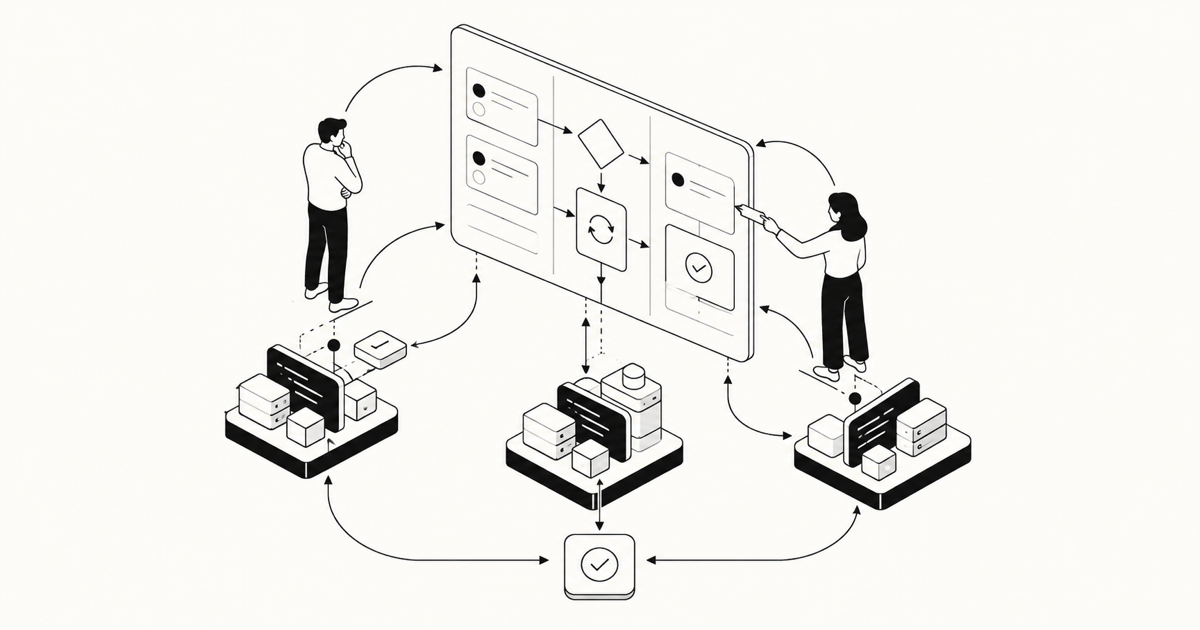
An agent is working on the API. Another is building the frontend. Your product owner changes a requirement, and the tech lead spots a compatibility issue.
How does that decision reach the work already happening?
If it stays in a private chat, the other agents can keep building against the old assumption. If every question lands with the engineer who started the run, that engineer becomes the person everyone waits for.
I think this is where the team workflow has to change. People need to participate while the work is being shaped, see which decisions are still open, and steer the change before those assumptions turn into several implementations.
In my June writing on collaboration, I described people and agents working together on requirements and architecture, approving the direction, and then moving into implementation. The useful part is the opportunity to make a decision while it can still change what gets built.
Keep human accountability clear as agents take on work
Start with the responsibilities your team already has.
Who can accept the requirement? Who decides a material architecture tradeoff? Who can change scope? Who reviews the result, and who authorizes release?
Agents can help with each of these responsibilities. A Product agent can expose an ambiguous requirement. An Architect agent can map the impact and propose options. Review and Verify agents can find problems and return evidence. The people accountable for the decisions still need to know what they are accepting.
For a small team, the same person may own several decisions. A larger team may divide them across product, engineering, platform, and release owners. You do not need a new org chart for every specialist agent.
A useful starting agreement is simple.
| Decision | Human accountability | Agent contribution |
|---|---|---|
| What behavior should we build? | Named owner accepts the requirement and scope | Clarify the request, find missing cases, and draft acceptance criteria |
| Which design tradeoff is appropriate? | Responsible technical owner accepts material tradeoffs | Retrieve context, map dependencies, and compare options |
| What can proceed independently? | Engineering owner sets boundaries and resolves conflicts | Propose bounded tasks and surface dependencies |
| Is the change ready for review? | Reviewer assesses the implementation and evidence | Resolve findings, execute checks, and expose gaps |
| Can this go to production? | Authorized release owner makes the release decision | Prepare rollout steps, verification evidence, and remaining risks |
These decisions should be explicit without requiring a person to approve every routine tool call. The right gates depend on the change, the team’s policy, and what could go wrong.
Follow one feature through the shared work
Take the customer-import feature from our parallel coding agents guide. An admin uploads a CSV, an API creates a job, a worker processes the rows, and the frontend shows the result.
The following collaboration sequence is illustrative, not a report of a customer run.
Before implementation, the Product agent asks what should happen if some rows are invalid. The product owner accepts an initial rule that the import rejects the file and explains the errors. The technical owner reviews the job contract and verification plan. Implementation starts against that accepted version.
While the work is running, the product owner joins the discussion and raises a new request.
Could we import the valid rows and provide a report for the rejected ones?
That sounds like a small improvement. It changes the worker’s behavior, the result the API exposes, the UI states, and the scenarios QA needs to check.
The Architect agent should make those consequences visible. The responsible owners can then decide whether to accept the change now or leave it for a later request.
Suppose they accept it. The requirement and contract receive new revisions. The affected implementation tasks need those inputs, and the earlier approval needs to be reconsidered where the change invalidates it. Work depending on the old behavior should pause or be superseded before it continues.
This is a meaningful intervention during the run. A person has changed the intended behavior, the impact is visible, and the downstream agents receive an explicit decision.
Give people a shared session they can understand
For this workflow, I would want a teammate joining the session to see the current state without reading every message.
Which requirement is accepted? What changed since implementation started? Which agent is working on which task? Is something blocked on a human decision or on a failed check?
The shared session needs a delivery record underneath it. Keep the current requirement, accepted decisions, relevant sources, artifact revisions, task owners, findings, and verification results connected to the change. Conversation helps people reason together. The record establishes which decision the work is following.
For the import feature, that record should make a few events easy to follow.
| Event | What the team needs to see |
|---|---|
| Initial behavior accepted | The requirement revision, owner, and agreed handling of invalid rows |
| Partial import proposed | The question, affected components, and who must decide |
| Change accepted | The new requirement and contract, affected tasks, and resume conditions |
| Implementation updated | The participating frontend, API, and worker revisions |
| Verification finds a problem | The scenario, expected behavior, observed result, and finding owner |
| Fix checked again | The changed revision, rerun result, and remaining gaps |
Real-time collaboration means people can see and influence the relevant work while it progresses. They should also be able to return later and understand what happened. Watching a live stream of agent messages cannot be the only way to stay informed.
The shared context guide covers the knowledge that should survive individual sessions and model changes. Here, the additional requirement is making that knowledge usable by another person joining the work.
Separate a suggestion from an instruction to change the work
A teammate might leave a comment, ask for an explanation, propose a different design, or approve an artifact. Those actions have different consequences.
The question about partial imports should not silently become an instruction for the worker agent to change behavior. The accepted requirement remains the reference until the authorized owner changes it.
The same applies when people disagree. Suppose the product owner wants partial success, but the technical owner points out that an existing consumer assumes the whole file is accepted or rejected. The agents can gather context and propose compatible options. They should bring the conflict to the people responsible for resolving it.
After the decision, record which option was accepted and where it applies. Make sure affected tasks receive that revision. A late response from an agent working on the earlier requirement should not be treated as completion of the revised task.
Access matters too. Being able to view a session should not automatically let someone approve requirements, change credentials, or authorize production work. Give people and agents the permissions their responsibilities require.
The Coordination Backbone article explains how agent proposals, saved state, and transition rules connect. Those controls give human collaboration a reliable way to affect execution.
Let review and QA work with the team while the change is still open
Now suppose the updated worker imports the valid rows, but the UI tells the admin that the entire import succeeded. Some customers were rejected, and the result page does not make that clear.
Verify should return the scenario and observed behavior to the responsible owner. The frontend agent can fix the display. If the accepted product behavior leaves the message ambiguous, the product owner needs to clarify it before the fix is accepted.
The finding belongs in the shared run, linked to the tested revisions. The team should be able to see who is addressing it and whether the updated behavior was checked again.
There may be several rounds. Review finds a contract issue, Implement fixes it, and review reassesses the change. QA then exercises the integrated flow, finds a user-visible failure, and returns it for another correction.
Give those loops a completion condition and an escalation path. If the same finding keeps coming back, or the fix expands the scope, the responsible person should be brought in to resolve what is preventing convergence.
A runnable verification sandbox lets the agents exercise the feature and collect useful feedback. The human reviewer still needs evidence tied to the actual code and environment, including what remains unverified. A sandbox pass and permission to release are separate decisions.
Make a teammate handoff possible without starting again
Suppose the engineer who started the import feature goes offline before verification finishes.
Another authorized engineer should be able to pick up the work and find the accepted partial-import decision, the current revisions, the failed UI scenario, and the latest fix. They should know whether they can resolve the remaining question or need another owner.
That is a useful test of whether the session is shared in practice.
If the replacement engineer has to ask the original person which chat contains the decision, the team is still depending on private context. If a test result belongs to a revision that has since changed, it needs reassessment before the new owner relies on it.
Keep the human handoff bounded. Transfer the current goal, accepted decisions and sources, completed work, blockers, next action, and authority to act. Preserve the earlier history without forcing the next person to treat every old comment as a current instruction.
Agree on when the team needs to pay attention
More agents can also create more questions, findings, and requests for approval. The team needs a way to distinguish work that can continue from a decision that needs someone now.
For the import feature, a request to expand the accepted behavior needs its owner. A failed authorization check needs the responsible engineering or security reviewer under the team’s policy. A routine implementation progress update can stay in the run record.
Make the notification useful. State the decision needed, the options or blocker, the affected artifact revision, and the work waiting on the answer. Route it to the relevant owner instead of interrupting the entire team.
You can start with a small operating agreement.
- Name the person accountable for each material decision.
- Define what agents can continue autonomously and what requires approval.
- Distinguish comments, proposed changes, and accepted instructions.
- Keep one current record of decisions, task state, and evidence.
- Agree how to pause, redirect, resume, and hand over work.
- Review repeated corrections before turning them into shared context, skills, or checks.
Adjust this to the team. A bounded bug fix may need a much lighter path than a feature changing a shared contract.
Try the workflow with a second person
To evaluate this setup, take one representative change and involve another teammate before it is finished.
Can they find the accepted requirement? Can they contribute to an unresolved question without accidentally changing approved scope? Can the right owner make a decision and see which tasks it affects? Can someone else continue the run with the correct permissions and current evidence?
Record how much human effort goes into explaining the work again, resolving conflicting directions, reviewing results, and repairing handoffs. Include blocked attempts. Use the real-change evaluation scorecard to assess whether the workflow helps the team deliver a verified change.
This is how I think about the software factory we are building with Prinevo. Shared context, agent responsibilities, human decisions, verification, governance, and learning need to stay connected as the work moves between people and agents. The delivery walkthrough shows how those responsibilities fit across the SDLC.
The team should be able to shape the change together, make the decisions that need judgment, and inspect what the agents actually verified before taking it forward.
To assess whether this collaboration improves delivery, read how to evaluate team speed when coding agents write faster.