Your team has coding agents. They can investigate a repository, implement a change, run tests and help with review. Why would you need a software factory as well?
A coding agent performs engineering work using the context, tools and permissions available to it. An agentic software factory is the delivery system around those agents. It connects the request, shared context, stage owners, handoffs, verification evidence and learning across the work.
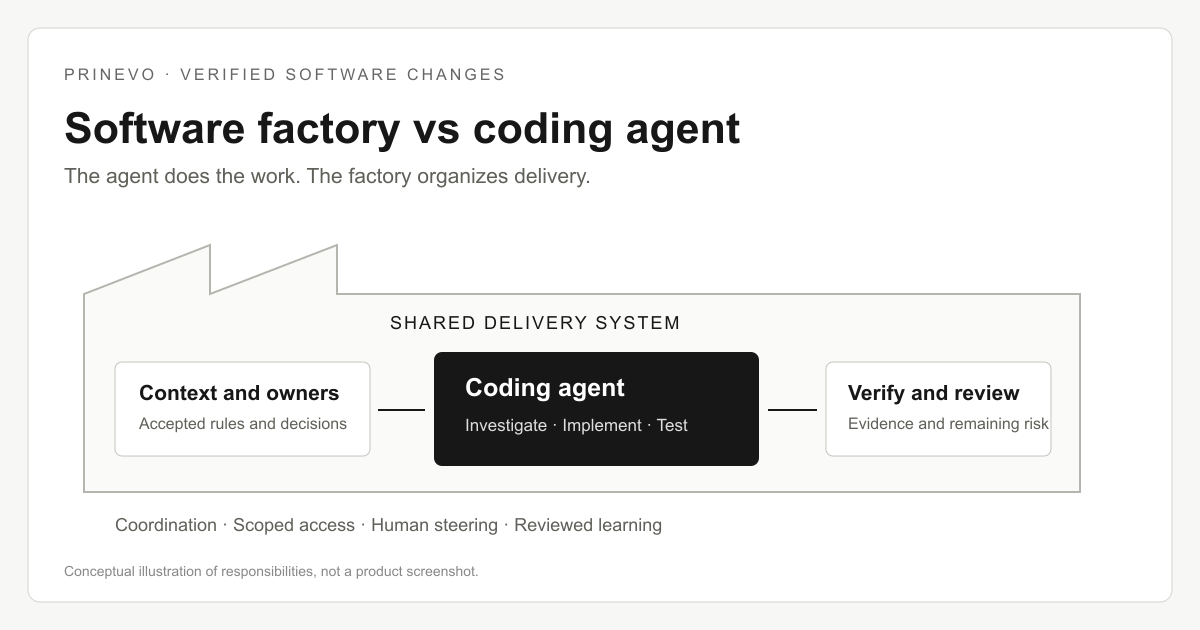
You may already have enough with a coding agent and a well-configured engineering workflow. I would look at a software factory when coordinating and verifying changes across people, repositories and sessions becomes recurring work that your existing setup handles poorly.
Here, I am using software factory to mean a delivery system built around coding agents. A team can build that system itself or use a platform. It does not require replacing the agents the team already uses.
Coding agents can do more than write code
The comparison gets misleading if we describe a coding agent as a code generator with no context or ability to test.
For example, Anthropic documents Claude Code exploring repositories, planning changes, writing and executing tests, reviewing PRs and working with an issue tracker. Its documentation also describes reusable skills. Those are substantial parts of an engineering workflow. Claude Code developer use cases.
An agent may also delegate work or participate in automation. The number of agents does not tell you whether the delivery system is reliable.
I would ask what happens when the requirement changes, a consumer is missed, verification fails or a different engineer takes over. Where is the accepted decision? Who owns the next step? Which revision did the verifier actually test?
Those questions reveal how the workflow operates beyond the individual task.
Compare the responsibilities around the agents
| Area | What a coding agent can do | What the factory needs to organize |
|---|---|---|
| Requirements | Read a ticket, ask questions and propose acceptance criteria | Keep the accepted behavior and later decisions available to every affected stage |
| Context | Use repository files, instructions and connected tools | Maintain shared sources, ownership and corrections across teams and runs |
| Coordination | Delegate tasks, produce artifacts and act on findings | Track dependencies, artifact revisions, accountable owners and allowed transitions |
| Verification | Run checks in an available environment and investigate failures | Provide the relevant services and data, connect checks to requirements and record the tested revisions |
| Human control | Request input or permission and respond to steering | Define who can approve a material decision and when work must pause or change scope |
| Learning | Apply feedback and propose a reusable correction | Review the correction, put it in the right context record, test, skill or workflow, and check whether it helps later |
| Reviewer handoff | Explain the diff and summarize results | Connect the request, code revisions, failed checks, fixes, reruns and remaining risks |
These responsibilities can be implemented with coding-agent tools, CI, repository conventions and internal automation. A separate platform is one way to organize them. The useful comparison is between the workflows your team can operate and maintain.
Follow a change through the frontend, API and worker
Consider an illustrative request to archive a project. The frontend needs an Archive action, the API needs to enforce permissions, and a background worker must stop creating new jobs for an archived project.
Assume the team accepts a clear rule. Jobs already running can finish, but no new jobs should start after archival. A viewer cannot archive the project.
The implementation can look straightforward in each repository. The frontend adds the action. The API stores the archived state. The worker checks that state before scheduling work.
Now consider a job queued just before the project was archived. The worker might still start it after archival. The UI and API tests can pass while the accepted behavior is wrong.
The agent may find and fix this. It needs the accepted rule, the worker dependency, a suitable environment and a check that exercises the timing boundary. Someone has to make sure those inputs and checks are part of the work.
When an engineer coordinates the workflow
The engineer carries the accepted rule between sessions, identifies the worker consumer, starts the services and asks for a verification check. If the check fails, they move the finding back to implementation and ask for a rerun.
That can work well. With a known boundary and a small change, the coordination may be modest. Count the work honestly before deciding it needs another system.
When the factory coordinates the workflow
The run should retain the approved rule and affected components. Each stage has an accountable owner. Implementation receives the relevant requirement and contract revisions. Review and verification can return findings to implementation, sometimes more than once.
Accepted request and shared context
    -> implementation
    -> code review <-> implementation fixes
    -> sandbox verification <-> implementation fixes
    -> evidence for human review
    -> authorized release decision
For the archive example, verification should establish whether a queued job starts after archival and whether an unauthorized user can archive the project. After a fix, the relevant checks must run against the corrected revisions. An earlier green result cannot validate code that changed afterwards.
If an accepted requirement is ambiguous or the environment is blocked, the run needs a visible owner and next action. Passing work between more agents does not resolve the missing decision.
The QA verification guide explains what the verifier should establish. The sandbox guide covers the environment needed to exercise those behaviors.
A factory still needs human judgment
An accountable owner does not need to approve every tool call. The approval points should follow the risk and the decisions involved.
A contained fix with known behavior may use a short implementation, review and verification path. A change to access rules, a shared contract or a migration may need a requirement or design decision before implementation continues.
In the archive example, changing the rule for already-running jobs is a product decision. An agent should surface that choice rather than quietly changing the requirement to fit its implementation.
Release also remains a separate concern. A sandbox can establish what was checked in that environment. Production rollout may still need deployment order, compatibility checks, monitoring and a rollback decision.
Learning needs somewhere useful to land
Suppose the reviewer discovers that the worker dependency was missed. Saving the whole conversation is useful history, but it does not establish what the next agent should rely on.
The team needs to identify the cause. Was the dependency absent from shared context? Was it present but not retrieved? Did verification omit the check? Could the sandbox not run it?
The durable change might be a corrected dependency record, a contract test, a skill or an environment fix. Give that change an owner, review it and check whether the next relevant run uses it. Retaining a lesson does not require retraining the model, and adding more instructions is not evidence that reliability improved.
When your current coding-agent setup is enough
Keep the simpler setup when your team can identify the affected behavior, run meaningful checks and give reviewers clear evidence without recurring handoff problems. Your engineers may already have shared instructions, working environments and automation that cover the responsibilities in the table.
Consider a factory when engineers repeatedly reconstruct the same context, coordinate dependent changes manually, repair verification paths or repeat corrections across sessions. Start with the bottleneck you can observe. A larger company or a larger agent count alone does not establish the need.
Where Prinevo fits
Prinevo's published workflow is built around shared context, accountable owners, specialist-agent handoffs, review loops and sandbox verification. It describes a shorter lane for bounded work, a fuller path for changes needing more decisions, and individual agents for specific tasks.
Evaluate that workflow against one change from your own team. Confirm the supported repositories, tools, models, environment and approval controls. Ask what the agents verified, what people still did and what evidence reached the reviewer.
Use the real-change evaluation scorecard to track human effort, interventions, verification gaps and reviewer rework alongside lead time. If you decide to build the operating system around your agents internally, the software-factory implementation guide maps the components and readiness checks.
You should be able to tell which delivery responsibility becomes easier to own after introducing the factory. That is the comparison I would make before adding another platform.